Posted on November 28, 2025 View all news
The sprawling homeless encampments in cities like Denver, Seattle, Portland, Los Angeles, and San Francisco have become impossible to ignore. Americans now see scenes of widespread addiction, mental illness, and street disorder unfolding in some of the country’s wealthiest, most politically progressive states. And while homelessness has many causes — housing costs, untreated mental illness, addiction, and poverty — one pattern stands out with uncomfortable clarity.
The states hit hardest by homelessness are overwhelmingly the same states that aggressively commercialized retail marijuana.
To be clear, marijuana legalization did not create America’s housing shortage. But in states that legalized cannabis early and enthusiastically, we are now living with the unintended consequences — and vulnerable people are paying the highest price.
The Pattern Is Too Consistent to Ignore
Eight of the ten states with the largest homeless populations — including California, New York, Washington, Oregon, Massachusetts, Arizona, Colorado, and Illinois — have legalized retail marijuana.¹ These states aren’t just dealing with high homelessness numbers; they’re grappling with rising levels of unsheltered homelessness, open-air drug scenes, and severe mental health crises.
Meanwhile, states without retail marijuana — such as Idaho, Kansas, Wyoming, and South Carolina — consistently report far lower homelessness rates.²
Correlation doesn’t automatically equal causation, but when the same pattern repeats itself across nearly every retail-cannabis state, it demands honest scrutiny.
Where Marijuana Legalization Meets Reality
Colorado: A Warning State
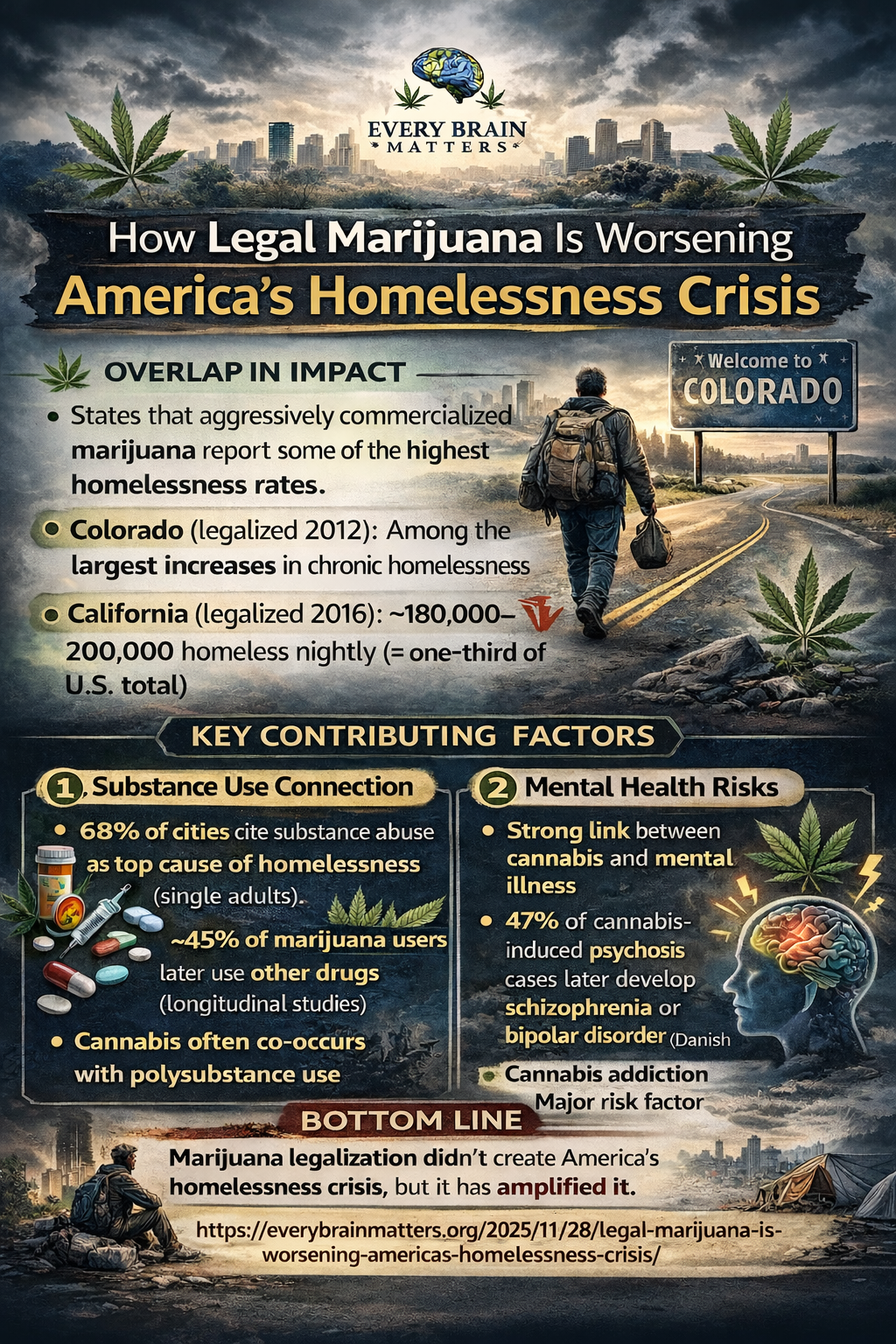
Colorado legalized recreational marijuana in 2012. Since then, it has seen one of the largest increases in chronic homelessness in America, according to HUD data analyses.³ Denver’s first-time homelessness has also surged, driven by a combination of addiction, mental illness, and soaring housing costs.⁴
Former Denver Mayor Michael Hancock said bluntly:
“This is one of the results of the legalization of marijuana in Denver.”
California: A Humanitarian Emergency
California legalized recreational cannabis in 2016. It now has roughly one-third of the nation’s homeless population, with around 180,000–200,000 people on a given night.⁵
Los Angeles County has seen homelessness roughly double since 2010, reaching about 75,000 in 2023.⁶ Sacramento’s homeless population rose 67% from 2019 to 2022, while the Bay Area now counts 38,000 homeless residents, a 35% increase since 2019.⁷
Housing costs are the primary driver — but addiction and mental illness are surging alongside visible street drug use, including widespread cannabis consumption.
Oregon & Washington: Ground Zero for Addiction-Linked Homelessness
Oregon declared a statewide homelessness emergency in 2023 after a 30% increase in Multnomah County between 2019 and 2022 — nearly 60% unsheltered.⁸
Washington’s homeless population rose 6.2% between 2019 and 2020, triple the national rate.⁹
Both states legalized cannabis early. Both have seen open-air drug markets take root.
Arizona & Nevada: Southwest States, Same Story
Arizona’s homeless population rose by nearly one-third between 2019 and 2022, after legalizing recreational marijuana in 2020.¹⁰ Nevada has documented some of the highest rates of substance use and mental illness among homeless populations nationwide.¹¹
Why Legal Marijuana Makes the Crisis Worse
Homelessness is rarely caused by a single factor. Instead, it emerges from a convergence of housing costs, economic instability, addiction, and mental health issues. Yet marijuana interacts with two of the most powerful forces driving homelessness: substance use disorders and serious mental illness.
1. Cannabis Often Co-Occurs With Other Drug Use
A major survey by the U.S. Conference of Mayors found that 68% of cities identified substance abuse as the top cause of homelessness among single adults.¹² And large longitudinal studies confirm that people whose first drug is marijuana are significantly more likely to later use other drugs — about 45% eventually do.¹³
Researchers debate the extent of a true “gateway” effect, but the real-world street pattern is unmistakable: people suffering from addiction rarely use only marijuana. In homeless encampments, cannabis is part of a broader polydrug environment.
2. Marijuana Causes Serious Mental Illness
An estimated 20–25% of the homeless population lives with a severe mental illness — compared to about 4–6% of U.S. adults overall.¹⁴
And marijuana’s connection to psychosis is now well-established. A massive Danish registry study found that 47% of people with cannabis-induced psychosis later developed schizophrenia or bipolar disorder — a higher progression rate than opioids, amphetamines, or hallucinogens.¹⁵ Another large study concluded that the primary environmental factor in young men developing schizophrenia is whether they develop a cannabis addiction.
Now that marijuana is more potent and common in legal states, it can accelerate mental instability and push individuals from crisis into street homelessness.
The Result: Cities in Crisis
When heavy marijuana use combines with:
- unaffordable housing,
- untreated mental illness,
- fentanyl and methamphetamine,
- permissive drug policies, and
- lack of psychiatric beds or dual-diagnosis treatment,
the result is predictable: the encampments of Denver, San Francisco, Portland, Seattle, and Los Angeles.
Marijuana legalization didn’t create America’s homelessness crisis, but it has amplified it in the states that embraced legalization most enthusiastically. The combination of potent cannabis, widespread availability, permissive norms, and fragile at-risk populations has created conditions that many leaders now describe as “unmanageable.”
The question facing policymakers is no longer simply whether marijuana should be legal. It is whether our communities can sustain the hidden costs — the addiction, the psychosis, the street disorder — that have followed legalization in state after state.
Ignoring the connection will not solve the crisis unfolding on our streets.
Aubree Adams, Director of Every Brain Matters
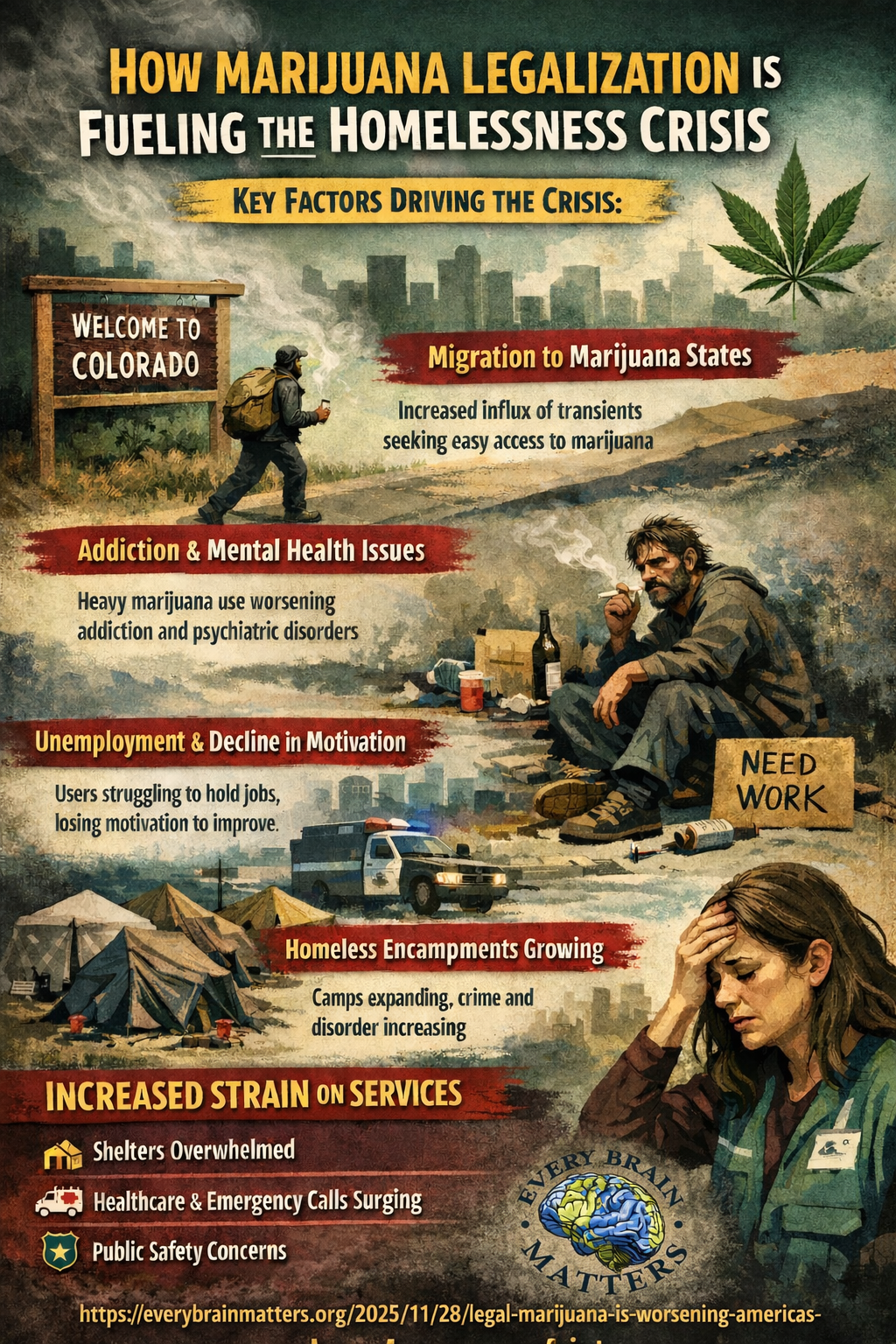
Use the graphic below to educate your communities.
ENDNOTES (Full References)
1. HUD 2023 Annual Homeless Assessment Report (AHAR) & US Interagency Council on Homelessness
States with largest homeless populations also have recreational cannabis.
Sources:
- U.S. Department of Housing and Urban Development (HUD), 2023 AHAR Part 1.
- USICH State Homelessness Data Profiles.
2. USICH State Profiles (Idaho, Kansas, Wyoming, South Carolina)
Low per-capita homelessness in non-recreational states.
https://www.usich.gov/homelessness-statistics/
3. Colorado chronic homelessness increases (2007–2020)
Analysis of HUD Point-in-Time data showing Colorado among highest increases in chronic homelessness.
HUD PIT Data Explorer: https://www.hudexchange.info/programs/hdx/pit-hic/
4. Denver first-time homelessness increase
Metro Denver Homeless Initiative, “2021 State of Homelessness Report.”
5. California homeless population (180,000–200,000)
HUD 2023 AHAR Part 1.
6. Los Angeles homelessness doubling since ~2010; 75,000 in 2023
LAHSA (Los Angeles Homeless Services Authority), 2023 Count Results.
7. Sacramento +67%; Bay Area 38,000 (+35%)
- Sacramento Steps Forward, 2022 PIT Count.
- Bay Area Council Economic Institute, “Bay Area Homelessness Report,” 2022.
8. Multnomah County +30% (2019–2022)
Joint Office of Homeless Services, Multnomah County, 2022 PIT Count.
9. Washington State +6.2% (2019–2020)
HUD 2020 AHAR.
10. Arizona homelessness up nearly one-third (2019–2022)
HUD PIT data (Arizona).
Arizona Housing Coalition/media analyses using PIT data.
11. Nevada: high rates of mental illness & substance use among homeless
Nevada Statewide Homeless Census & regional reports (Clark County, Washoe County).
12. U.S. Conference of Mayors, “Hunger and Homelessness Survey”
68% of cities cite substance abuse as primary cause of homelessness among single adults.
13. “45% go on to use another illicit drug”
https://daneshyari.com/article/preview/1075313.pdf
National Epidemiologic Survey on Alcohol and Related Conditions (NESARC).
Example study: Secades-Villa et al., Journal of Drug and Alcohol Dependence.
14. Severe mental illness: 20–25% among homeless vs. 4–6% general population
National Coalition for the Homeless; U.S. Substance Abuse and Mental Health Services Administration (SAMHSA).
15. “47% progression from cannabis-induced psychosis to schizophrenia/bipolar”
Nielsen et al., American Journal of Psychiatry, 2017.
Large Danish registry study on substance-induced psychosis.

Thank you for so accurately connecting the dots.