Posted on December 31, 2025 View all news
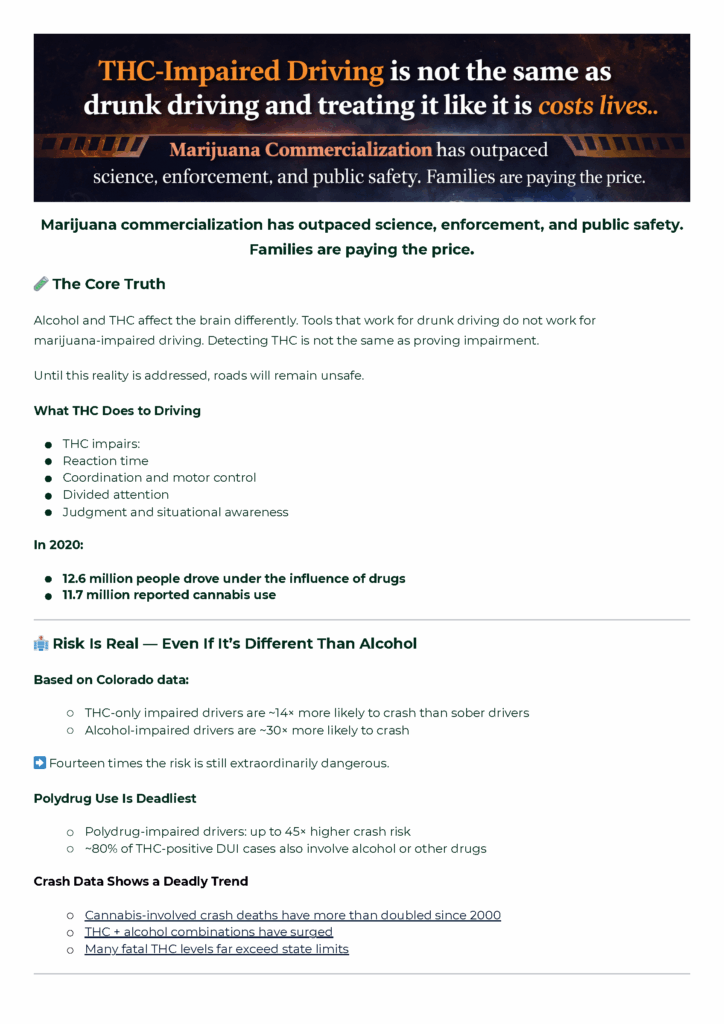
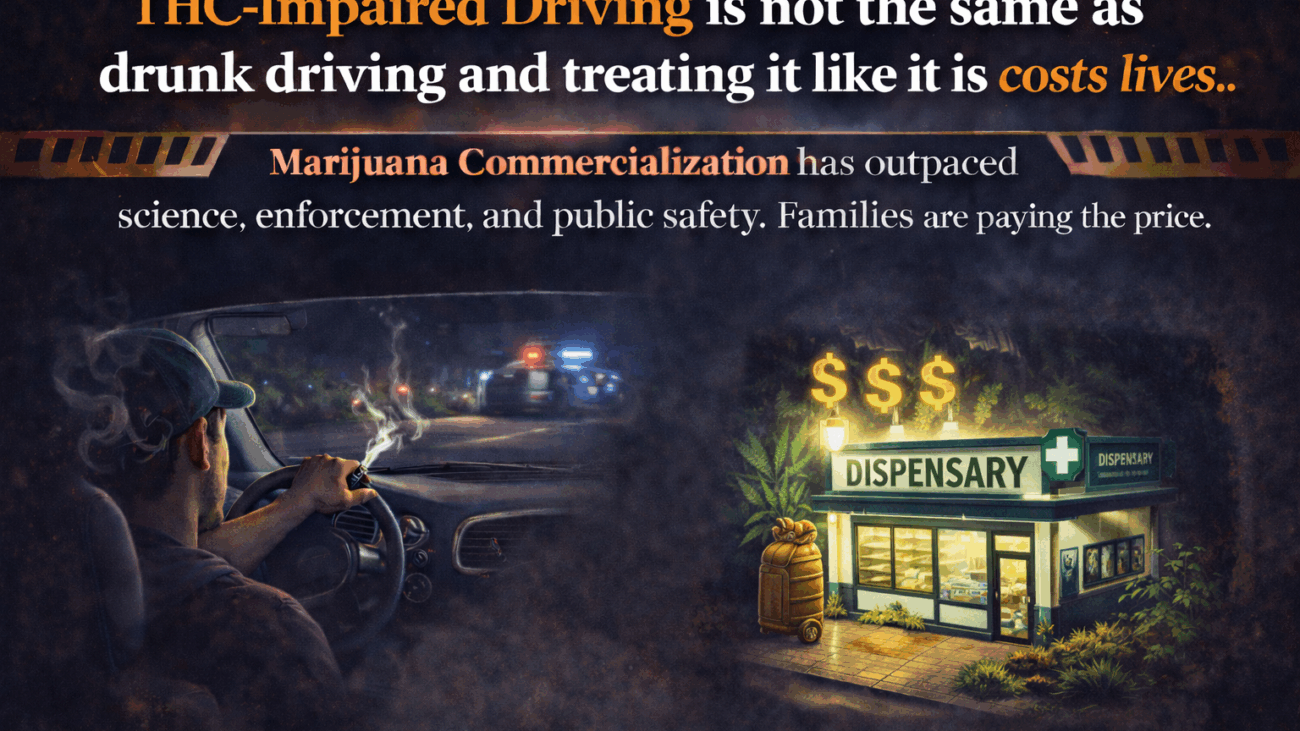
Marijuana commercialization has outpaced science, enforcement, and public safety — with devastating consequences for families.
Every year, families across the United States lose loved ones in crashes caused by marijuana-impaired drivers. These tragedies are not rare, random, or unavoidable. They are the foreseeable result of commercializing increasingly potent marijuana products without the ability to objectively assess THC impairment, as opposed to simply detecting drug presence.
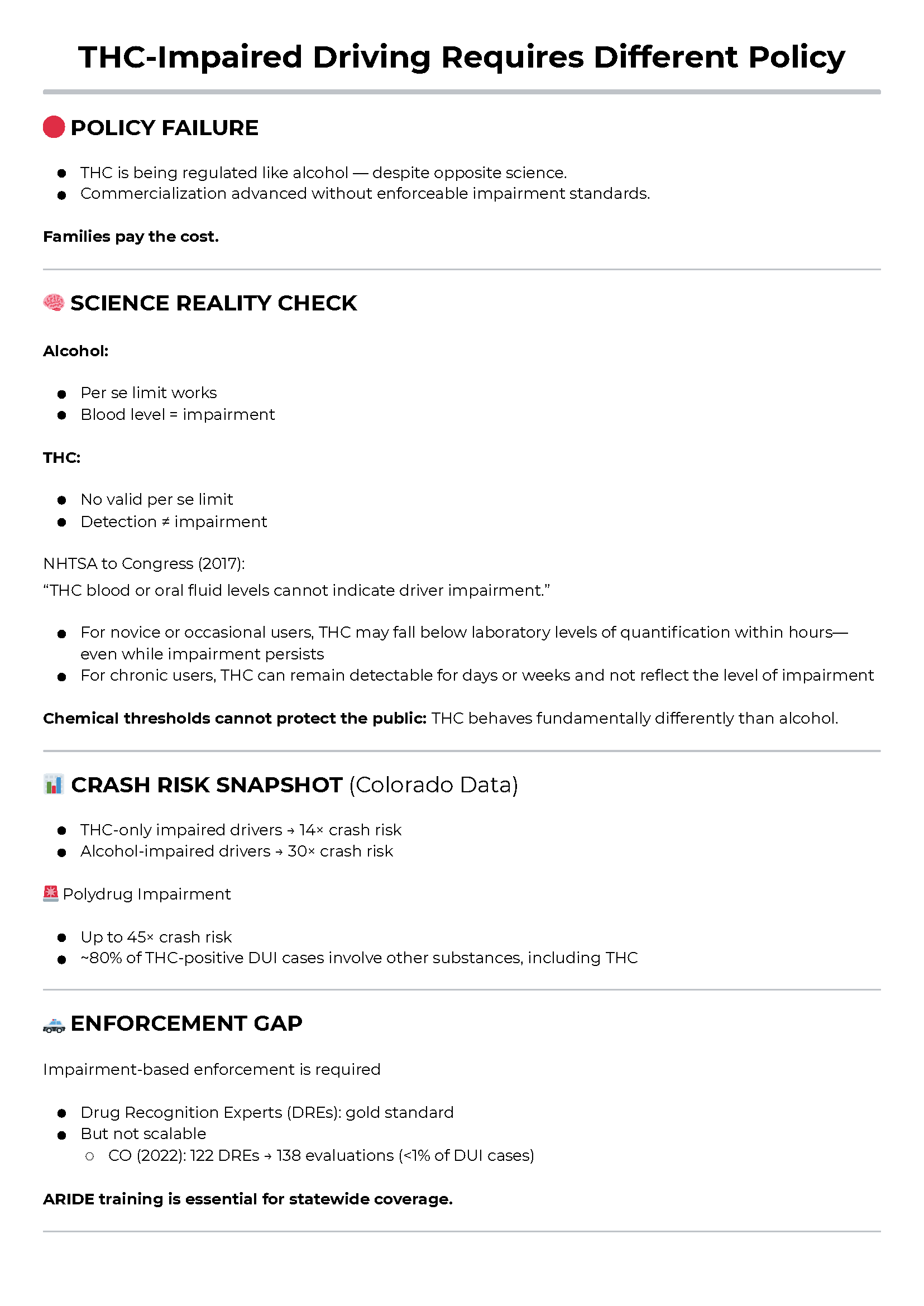
Public policy has largely treated THC-impaired driving as if it were equivalent to alcohol-impaired driving. It is not. THC behaves fundamentally differently in the human body, and the enforcement tools that work for drunk driving do not work for marijuana. Yet legalization and commercialization have moved forward as though this distinction does not matter.
It does. And families are paying the price.
Before any further expansion of retail marijuana, we must confront a hard reality: drug-impaired driving—especially THC-impaired driving—cannot be regulated, enforced, or prevented in the same way as drunk driving, and our current systems were never designed to do so.
THC-Impaired Driving Is Dangerous. It Kills and Maims.
THC significantly impairs reaction time, coordination, divided attention, judgment, and situational awareness. In 2020 alone, an estimated 12.6 million people drove under the influence of drugs, and 11.7 million had used cannabis.
To maintain credibility, it is important to acknowledge relative risk honestly.
Based on Colorado data:
- Drivers convicted of THC-only impaired driving are approximately 14 times more likely to crash than a sober driver
- Drivers convicted of alcohol-impaired driving are about 30 times more likely to crash than a sober driver
That distinction matters—but it does not mean THC-impaired driving is safe. Fourteen times the crash risk of a sober driver is still extraordinarily dangerous, and “average” drivers are rare. Many are far more impaired than the average reflected in conviction data.
Polydrug impairment is even more dangerous. Colorado data show:
- Polydrug-impaired drivers have crash rates up to 45 times higher than sober drivers
- Among drivers charged with DUI who test positive for THC, approximately 80% are polydrug users, not THC-only users
These combinations—THC plus alcohol or other drugs—are unfortunately common, underestimated, and deadly.
Families Harmed: Real Lives, Real Accountability
Behind every statistic is a family forever changed.
Amanda Hill — Colorado
Amanda Hill, 24, was killed by a driver who tested positive for THC and cocaine metabolite. The driver was convicted of impaired driving and sentenced to eight years in prison.
Amanda’s family fought not only for justice, but for truth. After persistent advocacy, Colorado approved an “impaired driving” memorial sign at her crash site—recognizing that impairment is not limited to alcohol.
Mason McClenathan — Colorado
Sixteen-year-old Mason McClenathan was killed when a THC-impaired driver lost control of his vehicle. The driver was convicted of vehicular homicide DUI. There is no ambiguity in this case—THC impairment was proven in court.
Waukesha Christmas Parade — Wisconsin
In 2021, six people were killed and more than 60 injured when a driver drove through the Waukesha Christmas Parade. After the attack, he rang a stranger’s doorbell, smelling of marijuana.
While mental illness and intent were central to the criminal case, the driver was ultimately sentenced to six consecutive life sentences for vehicular homicide DUI. This tragedy underscores the public-safety risks when drugs, instability, and access collide.
These families’ losses are not hypothetical risks. They are permanent.
Tools to Enforce Drugged Driving Laws Do Not Exist Like They Do for Drunk Driving Laws
Public discussion often refers to “testing,” which most people understandably interpret as something like alcohol BAC testing. That framing is misleading.
What we need is THC impairment assessment technology, not just drug testing.
The National Highway Traffic Safety Administration (NHTSA) has been unequivocal. In its 2017 report to Congress, NHTSA concluded:
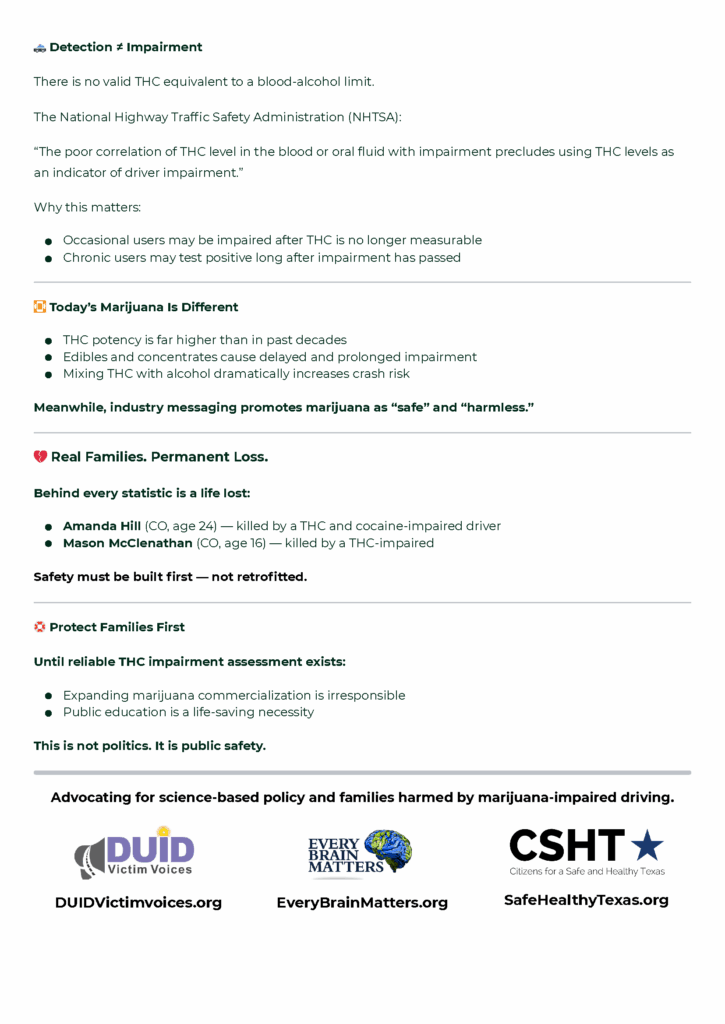
“The poor correlation of THC level in the blood or oral fluid with impairment precludes using THC blood or oral fluid levels as an indicator of driver impairment.”
This is not a research gap waiting to be solved. A scientifically valid THC per se level does not exist—and cannot exist. Like the fountain of youth, it is a myth.
THC behaves fundamentally differently than alcohol:
- For novice or occasional users, THC may fall below laboratory levels of quantification within hours—even while impairment persists
- For chronic users, THC can remain detectable for days or weeks and not reflect the level of impairment
This means blood THC levels can be too low to measure when a driver is impaired, or high when a driver is minimally impaired.
Enforcement, therefore, depends on trained officers observing impairment, not chemical thresholds. Drug Recognition Experts (DREs) represent the highest level of training—but relying on them is impractical. In Colorado in 2022, 122 DREs conducted only 138 evaluations, representing less than 1% of DUI cases. ARIDE-trained officers are less specialized but far more scalable and necessary.
As Ed Wood, longtime advocate for victims of drug-impaired driving and founder of DUID Victim Voices, explains:
“Government regulators have abdicated their responsibility to consider traffic safety in their zeal to loosen restrictions on marijuana commercialization. This failure is paid for by families.”
Education Is Needed — and Largely Absent
Despite rising THC potency and growing crash data, there is no comprehensive public education system comparable to decades of drunk-driving prevention efforts.
The public is rarely told that:
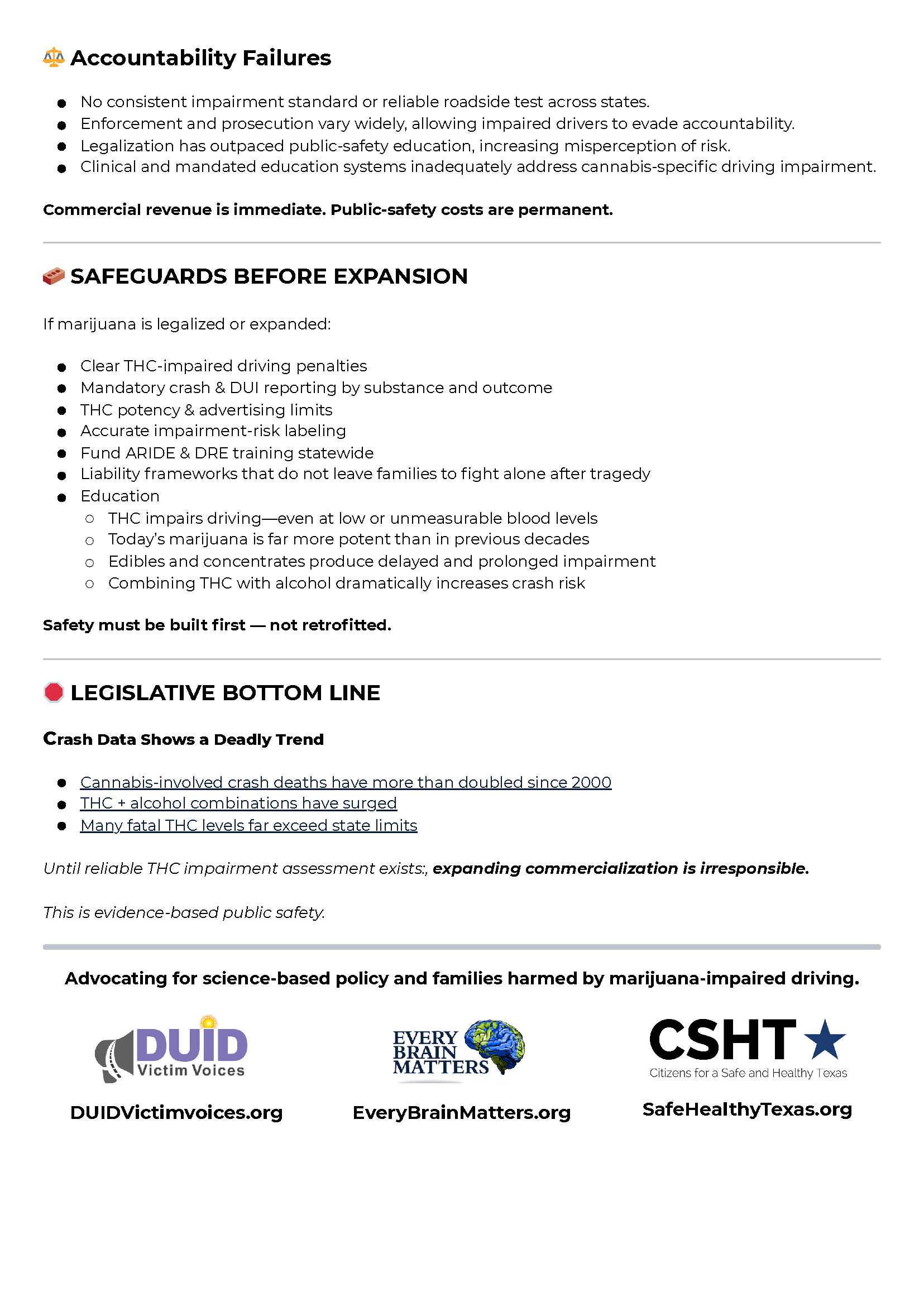
- THC impairs driving—even at low or unmeasurable blood levels
- Today’s marijuana is far more potent than in previous decades
- Edibles and concentrates produce delayed and prolonged impairment
- Combining THC with alcohol dramatically increases crash risk
Industry messaging fills these voids by promoting marijuana as “safe,” “natural,” and “harmless,” while families bury loved ones.
Enacting Legislation: Safeguards Must Precede Commercialization
The core problem is not legalization alone—it is commercialization without safeguards.
If marijuana is legalized or expanded, legislation must include:
- Clear penalties for THC-impaired driving, with transparent reporting of convictions and sentences
- Crash and DUI reporting by substance, including court outcomes—not just arrests
- Limits on potency and advertising, especially for concentrates
- Accurate labeling that reflects impairment risk, not marketing claims
- Statewide investment in impairment-based enforcement training (ARIDE and DRE)
- Liability frameworks that do not leave families to fight alone after tragedy
Safety must be built before commercialization—not retrofitted after lives are lost.
Protect Families First
Until reliable THC impairment assessment technology exists, promoting or expanding marijuana commercialization is irresponsible.
This is not a political argument. It is a public-safety obligation.
We owe families safety.
We owe them truth.
We owe them action.
Every Brain Matters
Every Brain Matters stands with families harmed by marijuana-impaired driving. We reject the false narrative that marijuana is harmless and advocate for policies grounded in science, accountability, and prevention.
Share this article. Save lives. Join the movement.
Ed Wood and Aubree Adams, on behalf of families and the Every Brain Matters Board of Directors
We encourage you to share the infographic below with your legislators and communities.
For Legislators
PDF File: https://everybrainmatters.org/wp-content/uploads/THC-impaired-Driving-for-Legislators-12.31.2025.pdf
For Communities
PDF File: https://everybrainmatters.org/wp-content/uploads/Thc-impaired-Driving-Public-Education-2.18.2026.pdf