Posted on January 19, 2026 View all news
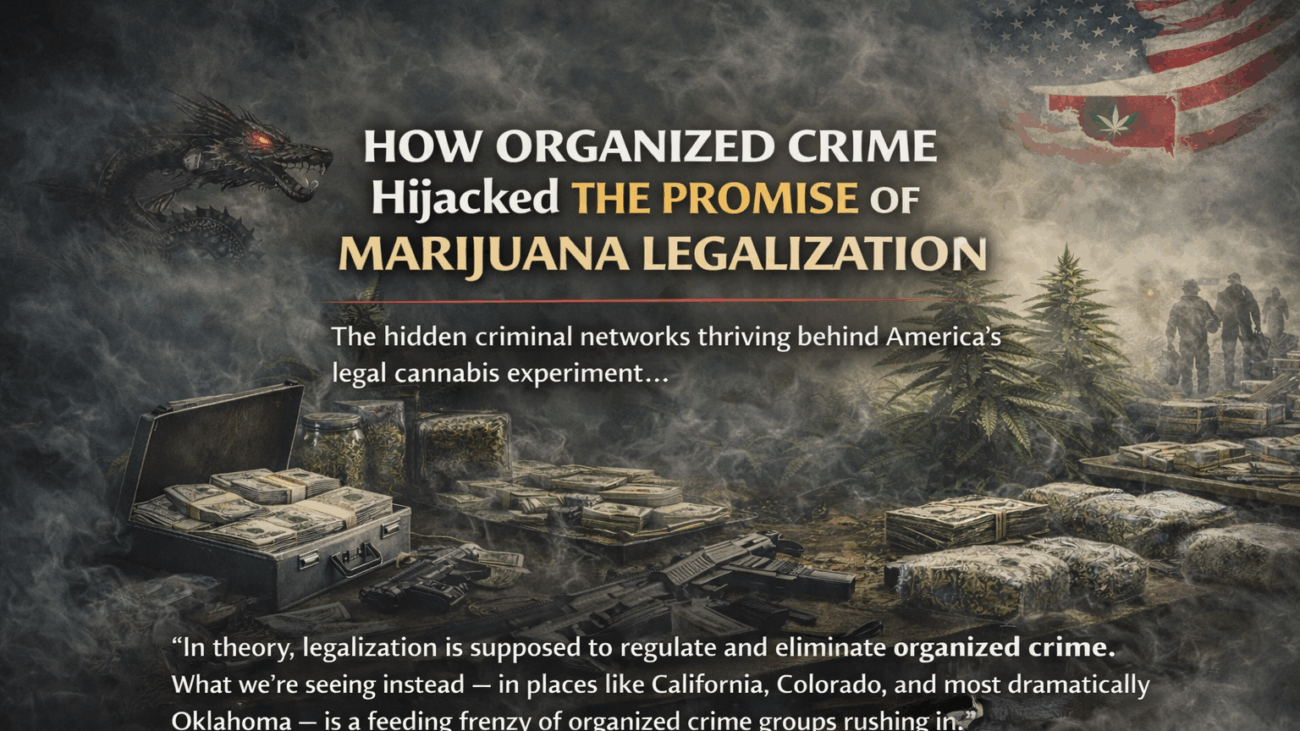
The hidden criminal networks thriving behind America’s legal cannabis experiment…
“In theory, legalization is supposed to regulate and eliminate organized crime. What we’re seeing instead — in places like California, Colorado, and most dramatically Oklahoma — is a feeding frenzy of organized crime groups rushing in.”
— Sebastian Rotella, Investigative Journalist, NPR
In California, which legalized marijuana in 2016, about 38 percent of marijuana is sold in the “legal” stores, according to a recent Senate committee hearing. If 60 percent of California marijuana is sold illegally, there is scant evidence that marijuana can be regulated. The state struggles to keep up with illegal growers despite law enforcement’s massive efforts to dismantle illegal distribution networks.
The Broken Promise of Legalization
Marijuana legalization was sold as a cure-all — a way to regulate the market, eliminate illegal sales, and choke off funding to organized crime. Nearly a decade later, that promise remains unfulfilled.
Illegal marijuana trafficking continues to thrive, fueled by sophisticated transnational criminal organizations that have adapted faster than regulators. These groups exploit weak oversight and modern technology, using legalized markets to mask large-scale illicit production and distribution. Rather than dismantling criminal networks, legalization has, in many states, helped strengthen them.
Chinese Organized Crime and the Marijuana Industry
“The profits from the marijuana trade allow Chinese organized criminal networks to expand their underground global banking system for cartels and other criminal organizations.”
— Donald Im, former senior official, U.S. Drug Enforcement Administration
Federal investigations and state enforcement actions reveal a disturbing trend: Chinese Transnational Criminal organizations have embedded themselves deeply within the U.S. marijuana supply chain.
Their involvement extends far beyond marijuana cultivation. These networks have been linked to:
- Large-scale money laundering operations
- Human trafficking and labor exploitation
- Armed enforcement and intimidation
- Collaboration with Mexican drug cartels
- Widespread ownership of American residential and agricultural land
Oklahoma: A Case Study in Criminal Exploitation
“Before marijuana legalization, Oklahoma was a pretty quiet state. We didn’t have Chinese criminal gangs coming here.”
— Tony Lie, President, Oklahoma Chinese Association
Oklahoma’s medical marijuana program became a textbook example of how weak regulation and inadequate law enforcement invite organized crime.
At its peak, the state issued nearly 10,000 grow licenses with minimal oversight and no meaningful limits on grow size. By listing a nominal local owner and obtaining an easily acquired license, foreign-backed groups constructed massive greenhouse complexes across rural farmland.
How Big Is the Problem?
- Over 80% of illegal grow operations shut down were linked to Chinese organized crime
- 800+ illegal farms closed in just two years
- The resulting shadow economy has been estimated at up to ten times Oklahoma’s state budget
Despite strict reporting requirements, the numbers don’t add up.
Between March 2024 and March 2025, growers reported cultivating 87.2 million marijuana plants, capable of producing an estimated 27 million to 192 million pounds of product. During that same period, licensed dispensaries sold just 1.6 million pounds — leaving tens of millions of plants and their output unaccounted for.
At a 2025 Congressional hearing, Oklahoma officials testified that over 85 million plants were missing, representing an estimated $153 billion black market.
In one coordinated enforcement action alone, authorities seized 40,000+ plants, 1,000+ pounds of processed marijuana, along with firearms and cash tied to Chinese organized crime.
Donnie Anderson, Director of the Oklahoma Bureau of Narcotics, summarized the crisis bluntly:
“Chinese organized crime has taken over marijuana in Oklahoma and the United States.”
Oklahoma to Texas: A Criminal Pipeline
“Criminal enterprises saw legalization as an opportunity to hide in plain sight by claiming compliance.”
— Wilson McGarry, Assistant U.S. Attorney, Oklahoma
Texas does not allow recreational marijuana — yet it is flooded with illegal cannabis originating from Oklahoma.
Prosecutors now describe Oklahoma as one of the largest suppliers of black-market marijuana in the country.
- In 2024, up to two-thirds of all DEA marijuana seizures nationwide were traced back to Oklahoma
- California accounted for just 15% by comparison
Traffickers use disguised delivery vehicles and legitimate-looking transport operations to move massive quantities of marijuana — sometimes tens of tons at a time — into Texas, New York, and beyond.
In one case, defendants transported 28 tons (56,000 pounds) of marijuana from a single Oklahoma grow operation.
The Staggering Scale of the Illicit Market
“We produce 64 times what’s consumed legally. That alone tells you the size of the black market.”
— Brian Surber, Deputy Director, Oklahoma Bureau of Narcotics
According to state tracking data and enforcement reports:
- Oklahoma’s illicit marijuana economy is estimated to be between $126 billion and $245 billion
- From 2018 to 2023:
- Marijuana plants seized increased by nearly 70,000%
- Pounds seized during highway interdictions rose 717%
- The share of highway marijuana seizures tied to Oklahoma grew from 15% in 2014 to 65% by 2023
This is not a side problem. It is an industrial-scale criminal enterprise.
Legal States, Same Outcome
“Normalization and commercialization became a magnet for international black market activity.”
— Bob Troyer, former U.S. Attorney, Colorado
Oklahoma is not an outlier — it is a warning.
- California continues to battle illegal grows worth tens of millions of dollars, many tied to Chinese money laundering networks
- Colorado and Washington face persistent diversion and illegal cultivation despite more mature legal markets
- New York saw legalization immediately followed by an explosion of illegal storefronts that overwhelmed regulators
As California’s head of cannabis enforcement admitted:
“The black market is very pervasive — and larger than the legal market.”
Legalization has not eliminated organized crime. In many cases, it has given it cover.
Violence, Exploitation, and Public Safety
“Marijuana cases are not one-dimensional. These groups traffic fentanyl money, guns, and people.”
— Ray Donovan, former Chief of Operations, DEA
Illegal marijuana operations are routinely linked to violence, coercion, and human exploitation — realities often ignored in legalization debates.
What Law Enforcement Has Found
- Violence and armed enforcement: Grow sites guarded by armed crews, fortified with booby traps and surveillance systems.
- Human trafficking and forced labor: Migrant workers recruited under false promises, held in debt bondage, forced to live on-site, and threatened with violence or deportation.
- Firearms and cartel collaboration: Illegal weapons, firearms trafficking, and direct ties to Mexican drug cartels.
In Oklahoma, raids on illegal grows linked to Chinese organized crime uncovered trafficked workers living in unsafe conditions under armed supervision. Similar labor camps have been dismantled in California, tied to international money laundering networks.
Chinese transnational criminal organizations now serve as the primary money launderers for Latin American drug cartels, enabling the fentanyl trade — the deadliest drug crisis in U.S. history.
Donald Im calls this system “the most extensive underground banking network in the world.”
What This Means for Texas
The lesson is clear: marijuana legalization invites organized crime.
Texas lawmakers must recognize:
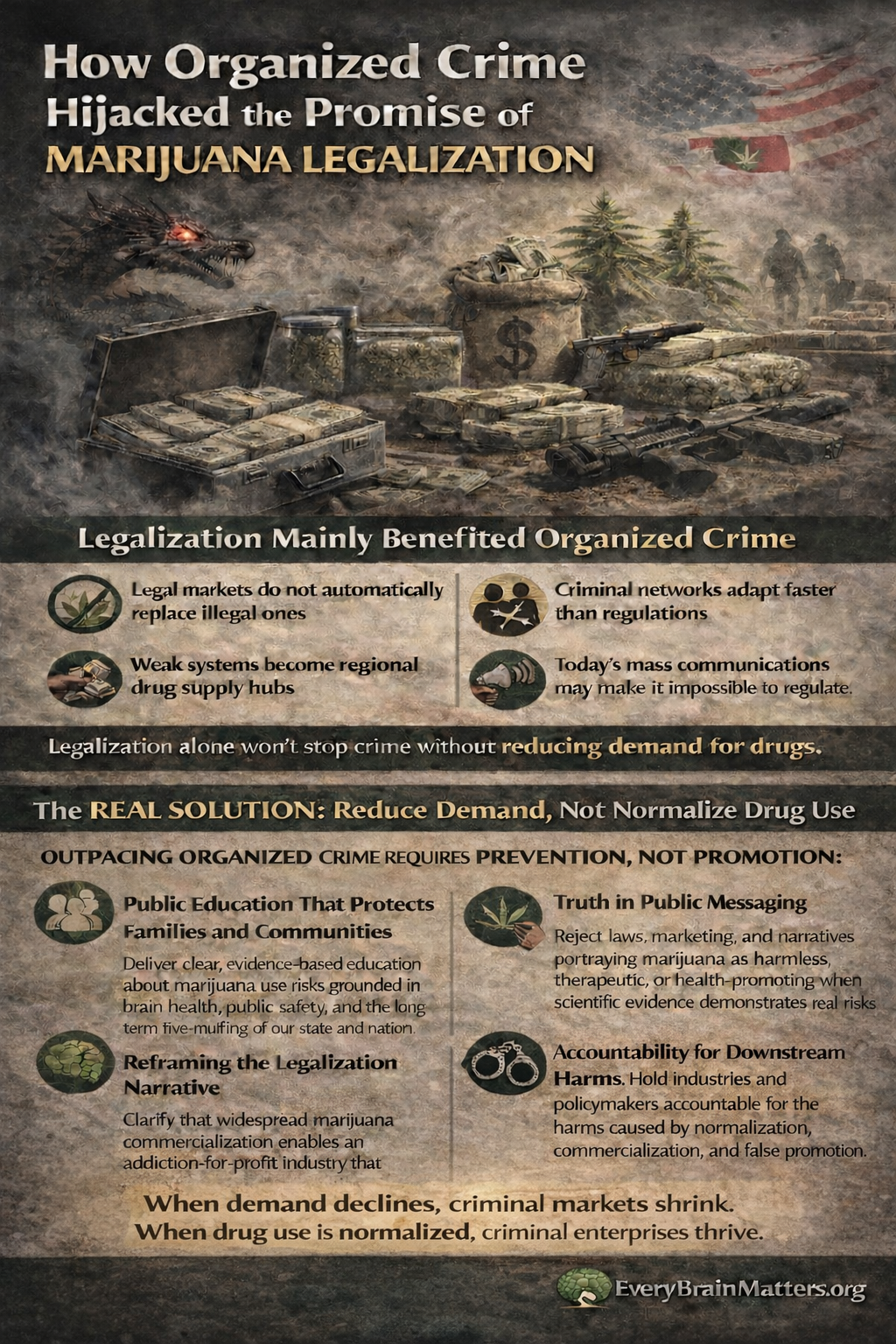
- Legal markets do not automatically replace illegal ones
- Criminal networks adapt faster than regulations
- Weak systems become regional drug supply hubs
- Today’s mass communications may make it impossible to regulate
Texas still has the opportunity to avoid the failures seen elsewhere — but enforcement alone is not enough.
The Real Solution: Reduce Demand, Not Normalize Drug Use
No regulatory framework can outpace organized crime as long as demand for marijuana remains high.
The most effective, evidence-based response is to reduce demand through prevention and education, not to normalize or promote drug use through expanded legalization and commercialization.
Achieving this requires:
- Public Education That Protects Families and Communities
Deliver clear, evidence-based education about the risks of marijuana use grounded in brain health, public safety, and the long-term well-being of our state and nation.
2. Reframing the Legalization Narrative
Clarify that marijuana legalization is not about protecting personal freedom, but about enabling an addiction-for-profit industry that embeds itself in communities, targets vulnerable populations, and drives preventable harms to public health and safety.
3. A Prevention-First Policy Approach
Advance policies that discourage initiation, delay first use, and reduce regular use and exposure to high-potency products.
4. Truth in Public Messaging
Reject laws, marketing, and public narratives that portray marijuana as harmless, therapeutic, or health-promoting when scientific evidence demonstrates real risks.
5. Accountability for Downstream Harms
Hold industries and policymakers accountable for the health, safety, and social consequences resulting from normalization, commercialization, and aggressive promotion.
When demand declines, criminal markets shrink.
When drug use is normalized, criminal enterprises thrive.
Our Position at Every Brain Matters
Every Brain Matters is a trusted educational resource that started as a project of Parents Opposed to Pot, which seeks to protect families and communities from the harms of marijuana and today’s pervasive drug crisis.
We reject the false narrative that marijuana is harmless. Scientific evidence and lived experience show that marijuana is addictive, damaging, and deeply intertwined with crime, exploitation, and violence.
The answer is NOT more access, more normalization, or more commercialization.
The answer is education, prevention, and policies that protect brains, families, and communities — not drug markets.
📢 Share this article and the infographics below widely.
📬 Join our national movement.
❤️ Support our work with a tax-deductible donation.
The truth matters. Every Brain Matters.
Jesse LeBlanc and Aubree Adams on behalf of the Every Brain Matters Board of Directors
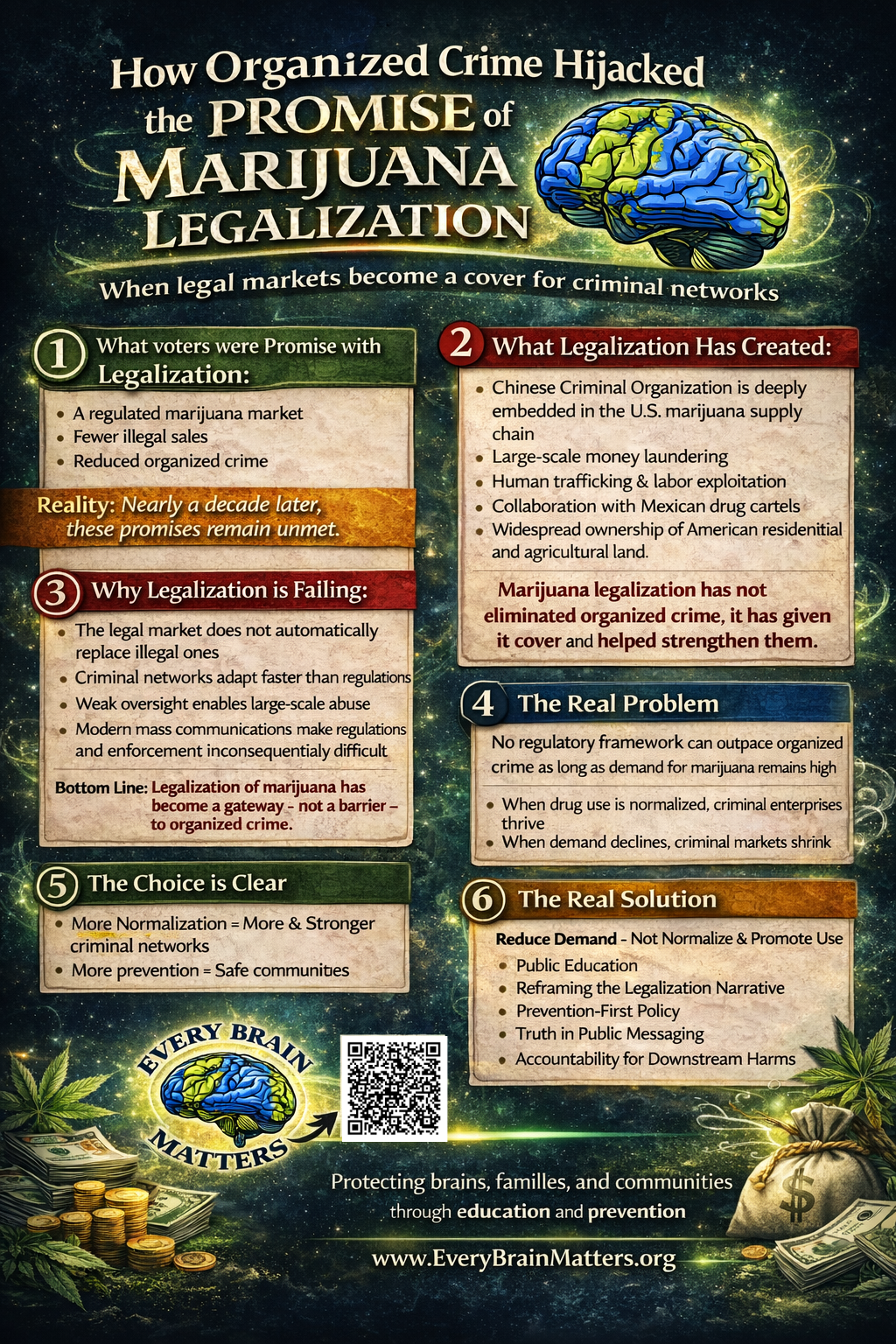
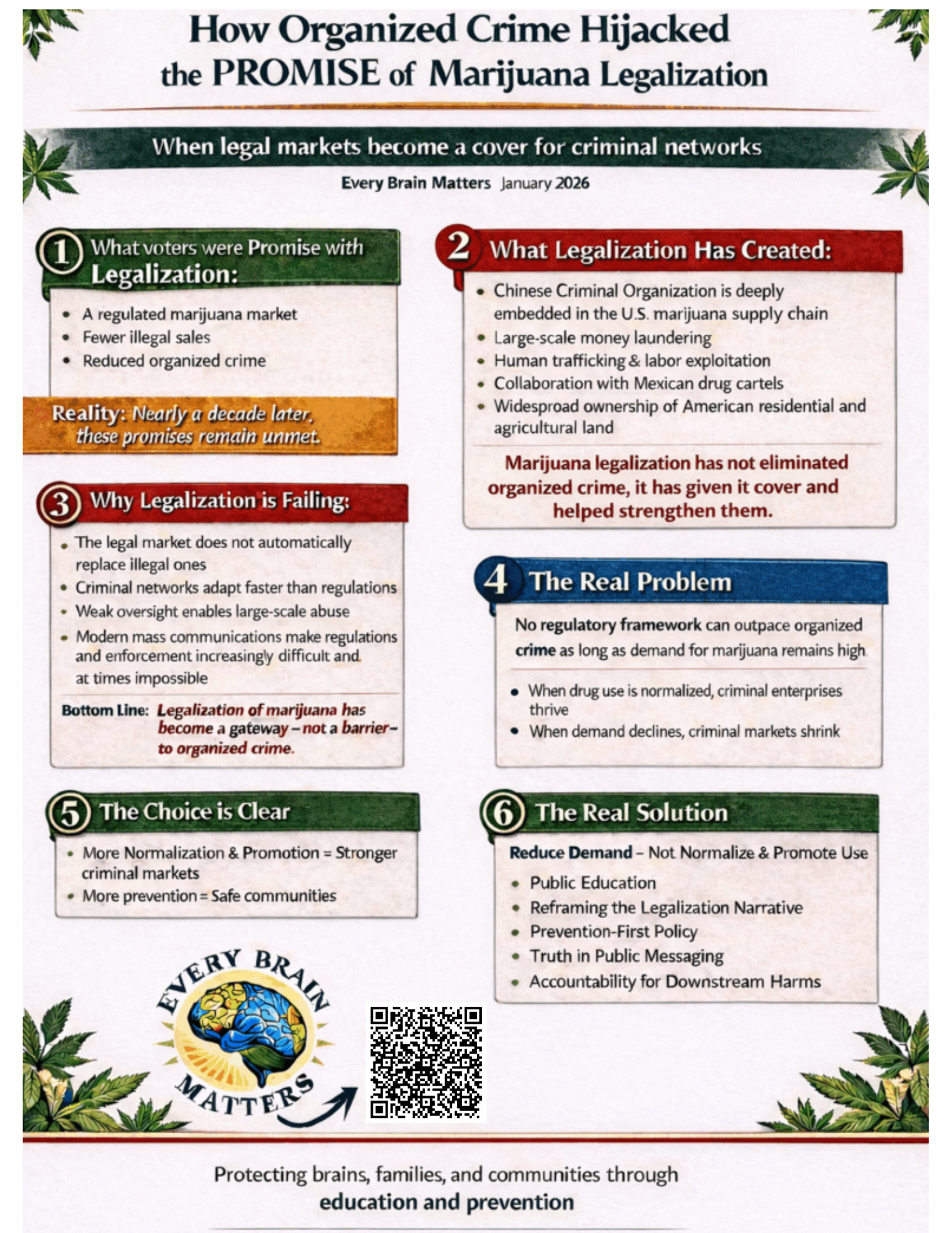
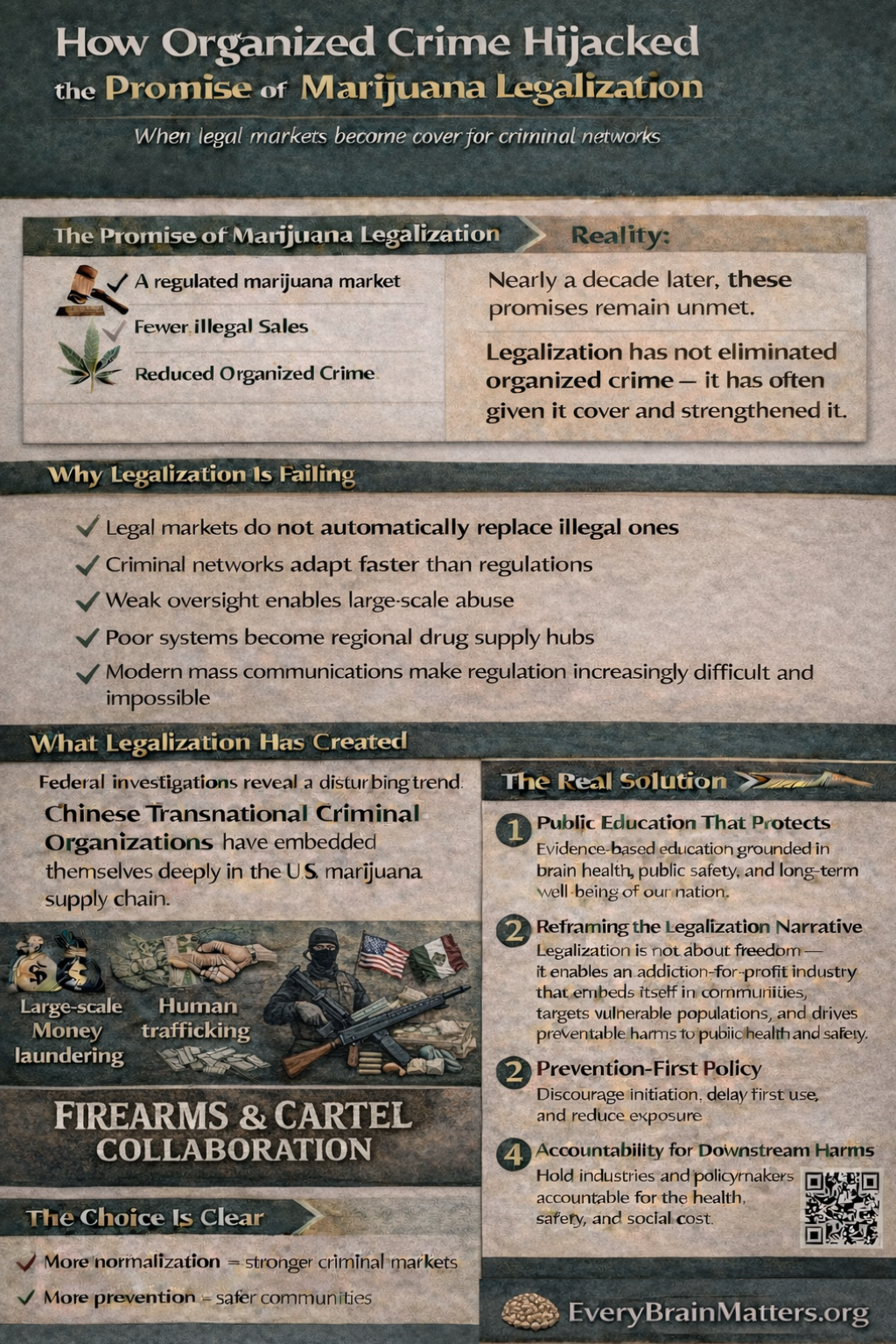
These three infographics summarize the article and convey the same message. Please share the one that best aligns with your community.

Reefer Madness is still alive in 2026! Pathetic!
And Prohibition works so well right Aubree!
Millions and millions of tax payers $ and nothing has changed!
Alcohol prohibition was a complete failure, just like you and your Karen groups, websites etc.
Cannabis is going nowhere!
I as an adult don’t need some Karen telling me what I can and cannot eat, drink, consume, smoke, etc. etc. etc.
I don’t like Oysters but I’m not going to yell at you or tell you to stop if you like Oysters!
So feel free to get the kiddos to stay away from Cannabis, while use ADULTS enjoy it!
FYI – 99% of consumers have ZERO problems with Cannabis, and that is a fact! Side effects from Cannabis are rare, and you can say the same about Prescription Meds, but I don’t see you screaming about prescription meds!