Posted on May 5, 2026 View all news
The Growing Doubts About Legal Weed
“Don’t repeat our terrible mistake. We were promised a safer city and a regulated market. What we got instead was a multi-billion-dollar industry that targets our neighborhoods and a rise in health issues we weren’t prepared for. It’s not the ‘harmless’ change we were sold.”
— Wellington Webb, former Mayor of Denver, Colorado
Not long ago, marijuana legalization was widely celebrated as a cultural and political milestone. Advocates promised a safer alternative to alcohol, a regulated marketplace, and even potential health benefits. For many Americans, legalization symbolized progress.
But today, that narrative is beginning to change.
Across the country, a growing number of researchers, clinicians, parents, and even former supporters of legalization are raising a difficult question:
Does America have a marijuana problem?
Concerns about addiction, mental health, youth exposure, and the rapid commercialization of high-potency cannabis products. The story of marijuana legalization, many argue, has become far more complicated than the public originally believed.
The Rise of High-Potency Cannabis
“We are seeing a new landscape of risk. With high-potency products, we aren’t just talking about a stronger ‘high’; we are talking about a fundamental shift in how the brain processes reality.”
— Dr. Nora Volkow, Director, National Institute on Drug Abuse
One of the most significant changes in the marijuana landscape is potency.
Today’s cannabis products are dramatically stronger than those used in previous decades. Advances in cultivation, extraction, and processing have created products with THC levels far beyond what earlier generations experienced. Concentrates, edibles, and vape cartridges have intensified these effects even further.
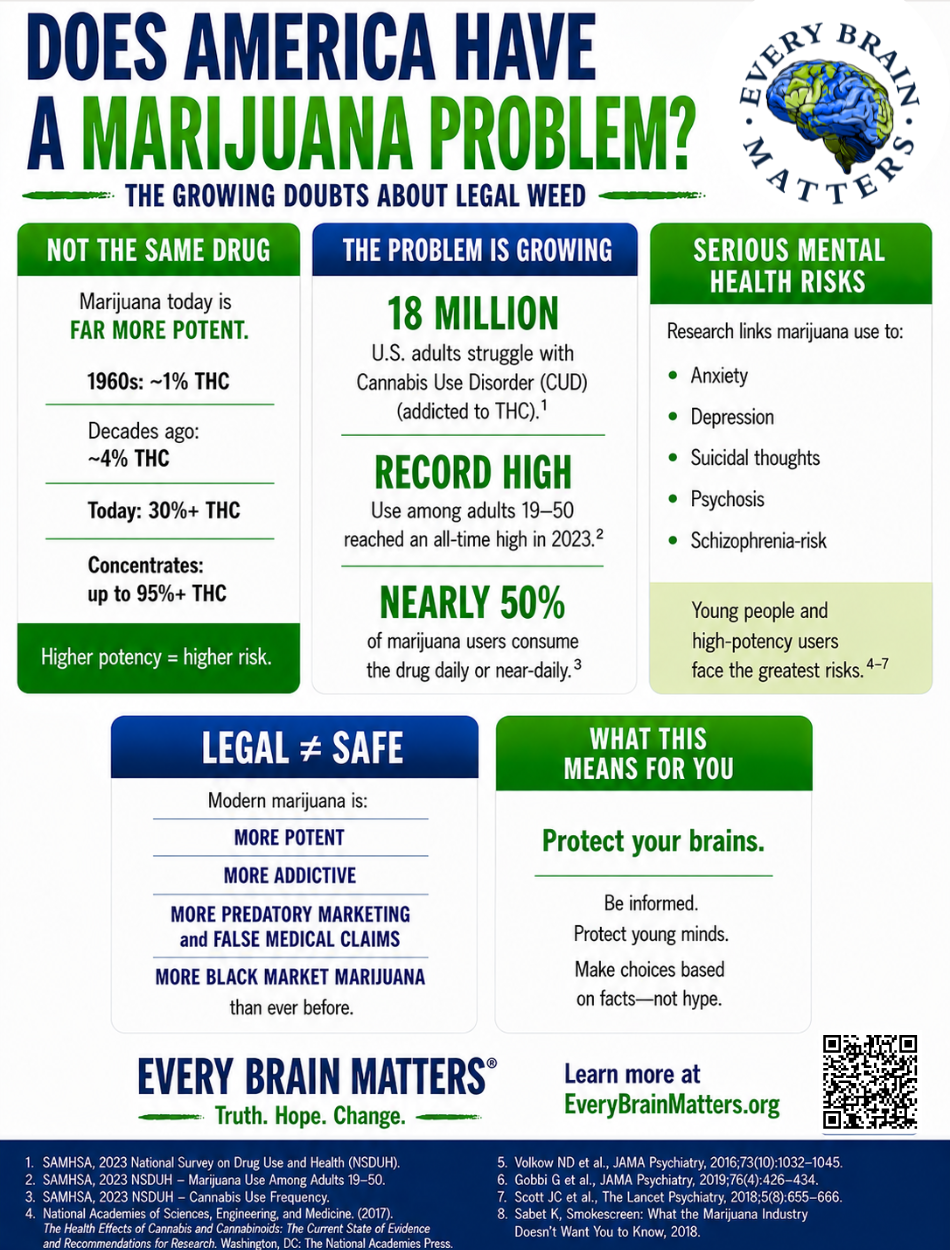
In the 1960s and 70s, marijuana commonly contained around 1% THC — the psychoactive compound responsible for the drug’s intoxicating effects. A generation ago, the average joint contained roughly 4% THC.
Today, many cannabis products sold in dispensaries routinely exceed 30% THC, while concentrated products such as oils, waxes, and “dabs” can exceed 95% potency.
Researchers warn that higher potency is increasingly associated with greater risks, including:
- Increased likelihood of dependency
- Stronger cognitive impairment
- Higher risk of psychosis and psychiatric complications
- Greater impacts on memory, attention, and motivation
Many experts now argue that modern cannabis bears little resemblance to the lower-potency marijuana commonly associated with earlier decades.[1][2]
Addiction: A Growing but Underestimated Risk
“We are witnessing a quiet catastrophe of the mind. This isn’t just about ‘getting high’; it’s about a substance that, in its modern high-potency form, can slowly take over a person’s identity and relationships.”
— Dr. Kevin Sabet, Smokescreen: What the Marijuana Industry Doesn’t Want You to Know
For years, marijuana was often described as “non-addictive” or only mildly habit-forming. But that perception is increasingly being challenged.
Research now shows that millions of Americans struggle with Cannabis Use Disorder (CUD), a condition characterized by dependence, cravings, withdrawal symptoms, and difficulty controlling use. The risks are especially high among people who begin using at a young age or who consume high-potency products [10 mg of THC or higher] regularly.
According to recent national estimates, roughly 18 million U.S. adults meet the criteria for Cannabis Use Disorder, highlighting the growing scale of marijuana dependency in America.[3]
Clinicians across the country report growing numbers of patients seeking help for marijuana-related problems, including:
- Anxiety and panic attacks
- Loss of motivation and emotional stability
- Sleep disruption and irritability
- Memory and concentration problems
- Relationship and academic decline
Research shows that people with Cannabis Use Disorder (CUD) face a significantly higher risk of developing alcohol and opioid use disorders, particularly with frequent or long-term cannabis use.[2]
The broader trends are equally alarming:
- In 2023, marijuana use among adults ages 19–50 reached an all-time high.[4]
- Nearly half of marijuana users now consume the drug daily or near-daily.[5]
- Addiction specialists warn that frequent use significantly increases the likelihood of dependency, cognitive impairment, and mental health complications.
Mental Health Concerns Are Becoming Harder to Ignore
“We have grown comfortable believing marijuana is benign while the science has rapidly evolved.”
— Alex Berenson, former New York Times reporter
Another major area of concern is the growing body of research linking marijuana use to mental health problems.
Studies have associated cannabis use — particularly high-potency THC products — with increased risks of:
- Anxiety disorders
- Depression
- Suicidal ideation
- Psychosis and schizophrenia-spectrum disorders
Young users and individuals with underlying mental health vulnerabilities appear to face the greatest risks.[6][7]
At the same time, many claims that marijuana is an effective treatment for mental health conditions are facing increasing scrutiny. Recent reviews have found limited evidence supporting marijuana as a reliable treatment for anxiety, depression, or other psychiatric disorders, while some studies suggest it may worsen symptoms for certain users.[8]
This creates a troubling paradox:
A substance often marketed as therapeutic may, in many cases, contribute to the very problems it claims to relieve.
Legalization Didn’t Eliminate Risks – It Changed Them
“We have normalized a drug that leads to more addiction and worse public health outcomes while creating a powerful commercial industry that profits from increased consumption.”
— Luke Niforatos, Executive Vice President, Smart Approaches to Marijuana
One of the central arguments for legalization was that regulation would make marijuana safer. By bringing the market out of the shadows, policymakers hoped to reduce crime, improve oversight, and protect consumers.
But the reality has proven far more complicated.
Legalization did not eliminate risks. In many ways, it transformed them.
Instead of a small underground market, the United States now faces a rapidly expanding commercial cannabis industry with enormous financial incentives to increase consumption. Advertising, product innovation, aggressive branding, and escalating THC potency have reshaped the marijuana landscape into a highly profitable business model.
In this environment, the line between regulation and promotion can quickly become blurred.
The Commercialization of Cannabis
As marijuana has become a legal industry, it has also become a highly competitive commercial enterprise.
Companies are developing new products, targeting new demographics, and creating increasingly potent forms of cannabis designed to maximize appeal and repeat use. Edibles, flavored vape cartridges, beverages, and concentrates are often packaged and marketed in ways that make them appear approachable — even harmless.
But commercialization brings its own dangers.
When profits depend on increased consumption, there is a natural incentive to minimize risks and normalize heavy use. Critics argue that this dynamic increasingly resembles the tactics once used by the tobacco and alcohol industries, where marketing often outpaced public health protections.[9]
Many Americans now wonder whether the country legalized marijuana — or unintentionally unleashed the next major addiction industry.
A Shifting Public Conversation
“We thought we were moving toward a more enlightened era of policy, but instead, we may have underestimated the public health consequences of widespread commercialization.”
— Richard Baum, former Director of the Office of National Drug Control Policy
Perhaps one of the clearest signs of change is the shift in public conversation.
Major media outlets, physicians, researchers, and even some former advocates of legalization are beginning to acknowledge the growing complexities surrounding marijuana policy.
The conversation is no longer centered solely on criminal justice or personal freedom.
Increasingly, it is about mental health, addiction, youth exposure, public safety, and the consequences of normalizing high-potency drug use across an entire culture.
What this Means for Public Health
“I supported decriminalization because I believed it would lead to treatment and freedom. Instead, we normalized an addictive industry while minimizing the human cost.”
— Michael Shellenberger, San Fransicko
From a public health perspective, the emerging concerns surrounding marijuana are difficult to ignore.
Rising potency, growing dependency rates, increased psychiatric risks, and widespread commercialization all point to a need for far greater caution and public awareness.
At the same time, normalization may make these dangers harder to communicate, especially to young people who increasingly view marijuana as harmless simply because it is legal.
But legality does not equal safety.
For individuals and families, informed decisions require understanding not only the promises surrounding marijuana, but also the growing body of evidence pointing to its potential harms.
A More complicated Story Than We Were Told
“We have grown comfortable believing marijuana is benign while the science has rapidly evolved. Modern marijuana is not the low-potency drug of the 1970s. It is a powerful intoxicant capable of triggering paranoia, dependency, and psychosis in vulnerable individuals.”
— Alex Berenson, former New York Times reporter
Marijuana legalization was once framed as a clear victory for public health, criminal justice reform, and personal liberty.
But as the evidence continues to evolve, that story is becoming far more complicated.
Growing concerns about addiction, mental health, youth exposure, and commercialization suggest the risks of modern cannabis may have been seriously underestimated. At the same time, the rapid expansion of the marijuana industry has created powerful financial interests with incentives to promote heavier and more frequent use.
The question is no longer just whether marijuana should be legal.
It is whether America is fully prepared to deal with the consequences of that decision.
You Can Make A Difference
Every Brain Matters is a trusted educational resource for individuals and families seeking to understand the risks associated with marijuana and today’s pervasive drug culture.
Awareness matters. Conversations matter. Truth matters.
Share this article and infographic.
- Help spread science-based awareness
- Support educational efforts that protect youth and families. Donte Here!
- Join the conversation at Every Brain Matters
Together, we can promote informed decisions grounded in evidence — not hype.
References
[1] ElSohly, M. A., et al. “Changes in Cannabis Potency Over the Last Two Decades.” Biological Psychiatry, 2016.
[2] National Institute on Drug Abuse (NIDA). “Cannabis (Marijuana) DrugFacts.” Updated 2024.
[3] Substance Abuse and Mental Health Services Administration (SAMHSA). National Survey on Drug Use and Health, 2023.
[4] University of Michigan, Monitoring the Future Study, 2023 findings.
[5] Hasin, D. S., et al. “US Adult Illicit Cannabis Use, Cannabis Use Disorder, and Medical Marijuana Laws.” JAMA Psychiatry.
[6] Di Forti, M., et al. “The Contribution of Cannabis Use to Variation in the Incidence of Psychotic Disorder Across Europe.” The Lancet Psychiatry, 2019.
[7] National Academies of Sciences, Engineering, and Medicine. The Health Effects of Cannabis and Cannabinoids, 2017.
[8] Bahji, A., et al. “Cannabis Use and Mental Health Outcomes: A Systematic Review.” Frontiers in Psychiatry.
[9] Hall, W., & Lynskey, M. “Why It Is Probably Too Soon to Assess the Public Health Effects of Legalisation of Recreational Cannabis Use in the USA.” The Lancet Psychiatry, 2020.