Posted on June 7, 2026 View all news
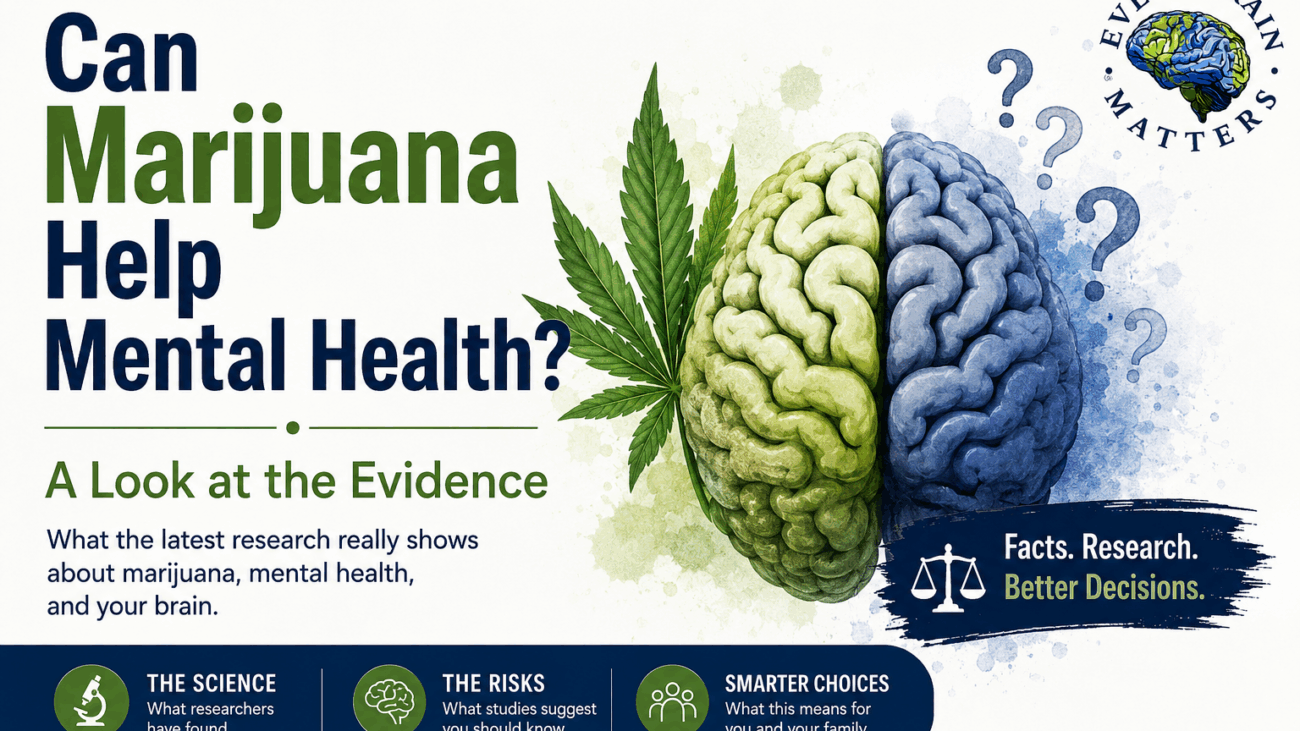
Many people believe marijuana helps with anxiety, depression, PTSD, and other mental health conditions. But what does the latest research actually show? Explore the evidence, potential risks, and what families need to know about cannabis and mental health.
For many people, marijuana has become synonymous with relaxation, stress relief, and even healing. As legalization has expanded across the United States, public perception has shifted dramatically. Today, cannabis is often viewed as a relatively harmless substance—and for some, a potential treatment for conditions such as anxiety, depression, and post-traumatic stress disorder (PTSD).
But does the science support those beliefs?
Recent research suggests the answer is more complicated than many people realize. While some individuals report short-term relief from symptoms, the strongest available evidence has not found cannabis to be an effective treatment for common mental health disorders. At the same time, researchers continue to identify links between regular cannabis use and a range of mental health concerns, particularly among young people and individuals already vulnerable to psychiatric conditions.
As families, educators, healthcare providers, and community leaders navigate an increasingly cannabis-friendly culture, understanding what the evidence actually says has never been more important.
What Researchers Found
In 2026, researchers reviewed more than 50 randomized controlled trials—the gold standard in medical research—to evaluate whether cannabis effectively treats anxiety, depression, PTSD, and related mental health conditions. (Wilson, J. et al. (2026). The Lancet Psychiatry)
Their conclusion was striking.
“We found no evidence any form of cannabis is effective in treating anxiety, depression or post-traumatic stress disorder, which are three of the leading reasons for which cannabis is prescribed.”
— Dr. Jack Wilson, University of Sydney’s Matilda Centre for Research in Mental Health and Substance Use
Researchers noted that studies reporting positive outcomes were often small, lacked strong controls, or could not be replicated in larger investigations.
This doesn’t mean people never feel better after using cannabis. Many users describe temporary feelings of calm, relaxation, or emotional relief. The challenge is that short-term symptom reduction is not the same as long-term treatment success.
Mental health professionals often distinguish between feeling temporarily better and actually improving the underlying condition. Current evidence suggests cannabis may provide the former without reliably delivering the latter.
Understanding the Risks
While evidence for mental health benefits remains limited, concerns about potential risks continue to grow.
Several large studies have found associations between regular cannabis use and higher rates of depression, anxiety, and suicidal thinking. Researchers are careful to note that association does not necessarily prove causation. However, the consistency of these findings across multiple populations has prompted increasing concern among mental health experts.
Research has also linked frequent cannabis use with a greater risk of psychosis and worsening symptoms among individuals already predisposed to serious mental illness.
“Cannabis is not an entirely side-effect-free substance. People with a pre-existing mental health condition … are more likely to experience a worsening of their baseline condition and to become dependent.”
— Dr. Marta Di Forti, King’s College London
These findings do not suggest that everyone who uses cannabis will experience mental health problems. Rather, they highlight the importance of understanding individual risk factors and making informed decisions based on evidence rather than assumptions.
Why Young Brains Face Greater Risk
One area where researchers are especially concerned involves adolescents and young adults.
The brain continues developing into the mid-twenties, particularly regions involved in decision-making, emotional regulation, impulse control, and memory. Exposure to psychoactive substances during this period may affect these developmental processes.
Studies following large populations of adolescents have found that earlier cannabis use is associated with increased risks of depression, anxiety disorders, and psychotic symptoms later in life.
While researchers continue to investigate exactly how these relationships work, many experts agree that delaying cannabis use until adulthood is one of the most important protective measures young people can take.
For parents and educators, these findings underscore the importance of having honest, evidence-based conversations with young people about marijuana and brain development.
The Self-Medication Challenge
Many individuals turn to cannabis not because they want to get high, but because they are seeking relief.
Stress, trauma, anxiety, insomnia, and depression can be overwhelming. When cannabis appears to help in the moment, it can feel like a solution.
The problem is that temporary relief can sometimes mask deeper issues. Some individuals find themselves increasing use over time, relying on higher-potency products, or postponing evidence-based treatments that may provide more lasting improvement.
Mental health experts often encourage people experiencing persistent symptoms to work with qualified professionals who can help identify treatments supported by long-term clinical evidence.
“Evidence from randomized clinical trials does not support the use of cannabis or cannabinoids for most conditions for which it is promoted.”
— Dr. Michael Hsu, UCLA Department of Psychiatry and Biobehavioral Sciences
Why Public Perception and Research Don’t Always Align
Public attitudes toward marijuana have changed rapidly, often faster than the science itself.
Personal experiences, social media stories, and widespread legalization have contributed to the belief that cannabis is broadly beneficial for mental health. While these experiences may feel compelling, individual anecdotes cannot determine whether a treatment is safe or effective for the broader population.
Researchers have also noted that some medical marijuana programs permit cannabis use for conditions such as anxiety, PTSD, and depression despite limited clinical evidence supporting those indications.
This gap between public perception, policy, and scientific evidence continues to generate debate among researchers, healthcare professionals, and policymakers.
Practical Guidance for Individuals and Families
If You’re Considering Cannabis for Mental Health
- Talk with a qualified healthcare or mental health professional first.
- Understand that cannabis has not been shown to be an effective treatment for anxiety, depression, PTSD, or most common mental health disorders.
- Be cautious about relying on short-term symptom relief as evidence of long-term benefit.
- Consider evidence-based treatments that have been rigorously studied and shown to improve outcomes.
If You’re a Parent or Caregiver
- Recognize that adolescent brains are especially vulnerable to psychoactive substances.
- Stay informed about the latest research on cannabis and brain development.
- Encourage open, nonjudgmental conversations with young people.
- Support healthy coping strategies and evidence-based mental health care.
A Continuing Conversation About Brain Health
The latest research does not support cannabis as an effective treatment for anxiety, depression, PTSD, or most other common mental health disorders. At the same time, growing evidence points to potential risks, particularly for young people and individuals with existing mental health vulnerabilities.
This doesn’t mean every person who uses cannabis will experience harm. Nor does it mean every question about cannabis has been answered.
It does mean that decisions about marijuana should be informed by evidence rather than assumptions.
As research continues to evolve, one principle remains clear: protecting mental health begins with understanding the facts. Whether you are a parent, educator, healthcare professional, or community member, staying informed is one of the most effective ways to support healthy decision-making. Conversations about marijuana should be guided by evidence, not assumptions.
Aubree Adams, Director
About Every Brain Matters
Every Brain Matters is a nonprofit organization dedicated to helping individuals and families make informed decisions about marijuana and other substances through education, research, and awareness.
We believe conversations about cannabis should be guided by credible evidence, open dialogue, and a commitment to protecting brain health—especially for young people.
If you found this article helpful, consider sharing it with friends, family members, educators, healthcare professionals, and community leaders. Together, we can encourage informed discussions and promote healthier futures through knowledge and understanding.
Please consider making a donation to support our work.
Research Sources
Readers interested in exploring the research discussed in this article may find the following sources helpful:
Wilson, J. et al. (2026). The Lancet Psychiatry
Systematic review of randomized controlled trials examining medicinal cannabis for depression, anxiety, PTSD, and other mental health conditions. The review found no evidence supporting cannabis as an effective treatment for these disorders.
University of Sydney summary:
https://www.sydney.edu.au/news-opinion/news/2026/03/17/no-evidence-to-suggest-medicinal-cannabis-is-effective-for-depre.html
UCLA Health / JAMA Review
Review of clinical evidence evaluating the effectiveness of cannabis and cannabinoids for commonly promoted medical conditions.
https://www.uclahealth.org/news/release/evidence-lacking-medical-cannabis-most-conditions
Scientific American
Coverage examining the growing gap between public perception of cannabis as a mental health treatment and the available scientific evidence.
https://www.scientificamerican.com
STAT News
Reporting on medical marijuana policies and the evidence supporting—or failing to support—certain psychiatric indications.
CNN Health
Coverage discussing the distinction between temporary symptom relief and long-term mental health treatment outcomes.
King’s College London – Institute of Psychiatry, Psychology & Neuroscience
Research examining the relationship between cannabis use, psychosis risk, and mental health outcomes.
About the Evidence
Research on cannabis and mental health continues to evolve. Readers are encouraged to review original studies and consult qualified healthcare professionals when making decisions about treatment options for mental health conditions.