Posted on February 10, 2026 View all news
Legislators must look past marketing spin and confront documented harms.
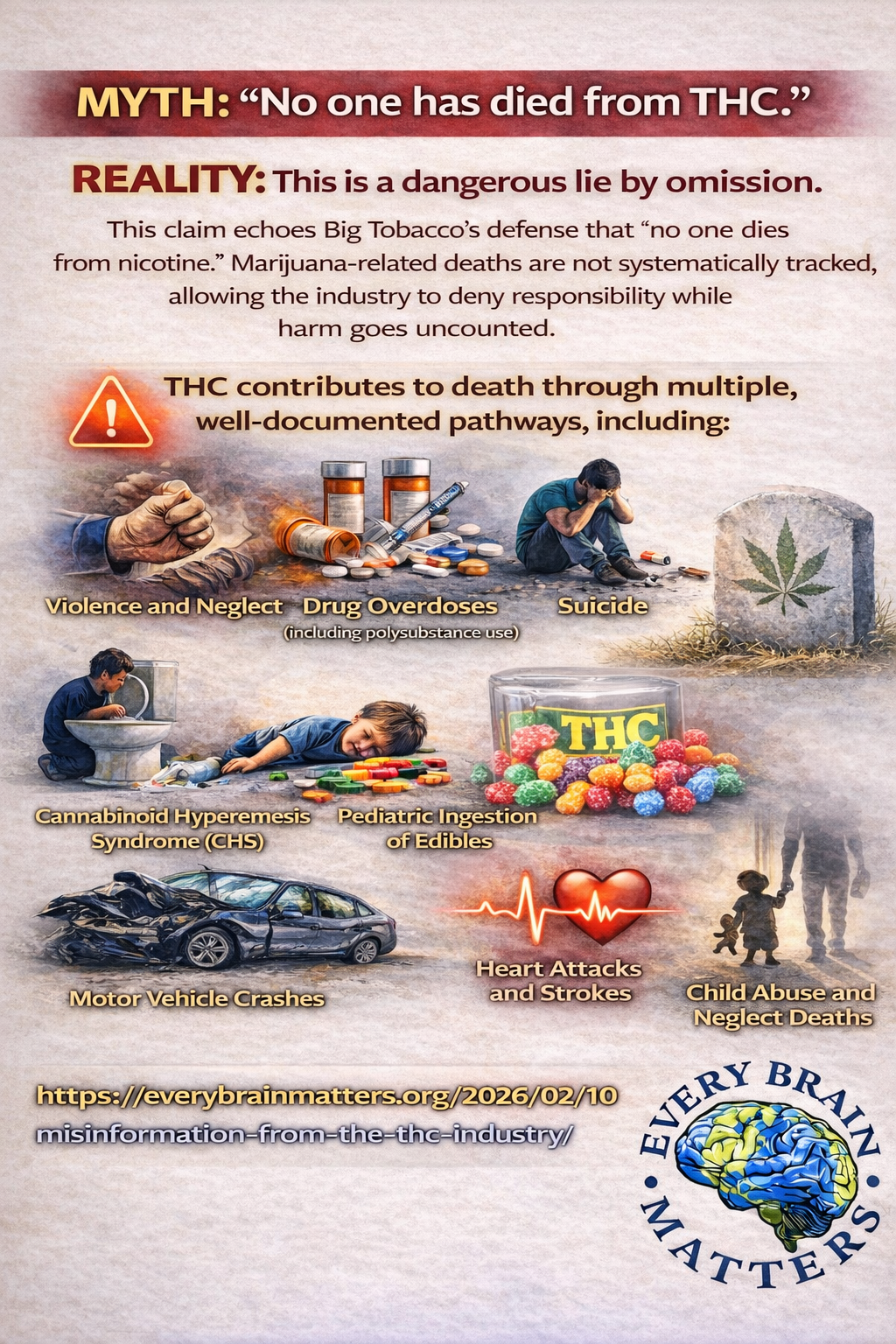
Myth: “No one has died from THC.”
Reality: This is a misleading lie by omission.
This claim mirrors Big Tobacco’s infamous line that “no one dies from nicotine.” Marijuana-related deaths are not systematically tracked, allowing the industry to deny responsibility while harm accumulates. THC is implicated in deaths through multiple pathways, including:
- Violence and neglect
- Drug overdoses (including polysubstance use)
- Suicide
- Cannabinoid Hyperemesis Syndrome (CHS)
- Pediatric ingestion of edibles
- Motor vehicle fatalities
- Cardiovascular events (heart attacks and strokes)
Child Abuse and Neglect Deaths (Texas)
The Texas Department of Family and Protective Services confirms that marijuana (THC) is the most common drug used by perpetrators in child abuse and neglect fatalities.
Source: 2023 DFPS Fatality Report, p. 21
Drug Overdose Deaths
Suicide Risk
- Individuals with bipolar disorder or major depressive disorder
- Military veterans
- The general population
Several studies indicate dose-response effects, with heavy and long-term use linked to worse outcomes. Evidence of a causal relationship has been identified for suicidal ideation in at least one study.
Violence and Psychosis
- THC-induced psychosis has been linked to acts of violence, including documented cases of mass shootings. The industry routinely dismisses this risk despite growing clinical evidence.
- Among those who committed mass shootings, a significantly higher proportion had cannabis involvement in the period from 1996 onward compared with before 1996 (11.2% vs 4.9%, p = 0.002)
Cannabinoid Hyperemesis Syndrome (CHS)
Edible Ingestion
THC edibles—especially high-potency products—pose serious risks:
- Severe respiratory depression
- Cardiac arrest
- Pediatric overdoses
Texas cases include:
- Tanner Clements, who died after consuming half of a CBD edible
- An East Texas woman charged after a toddler overdosed on THC
- A Texas man charged after giving his daughter THC chocolate, sending her to the hospital
Road Fatalities
Journal of Studies on Alcohol and Drugs (2022 July) shows that legalization combined with retail sales is associated with:
- 5.8% increase in injury crash rates
- 4.1% increase in fatal crash rates
Heart Attacks and Strokes
The Journal of the American Heart Association found that any marijuana use was associated with:
- 25% increased risk of heart attack
- 42% increased risk of stroke
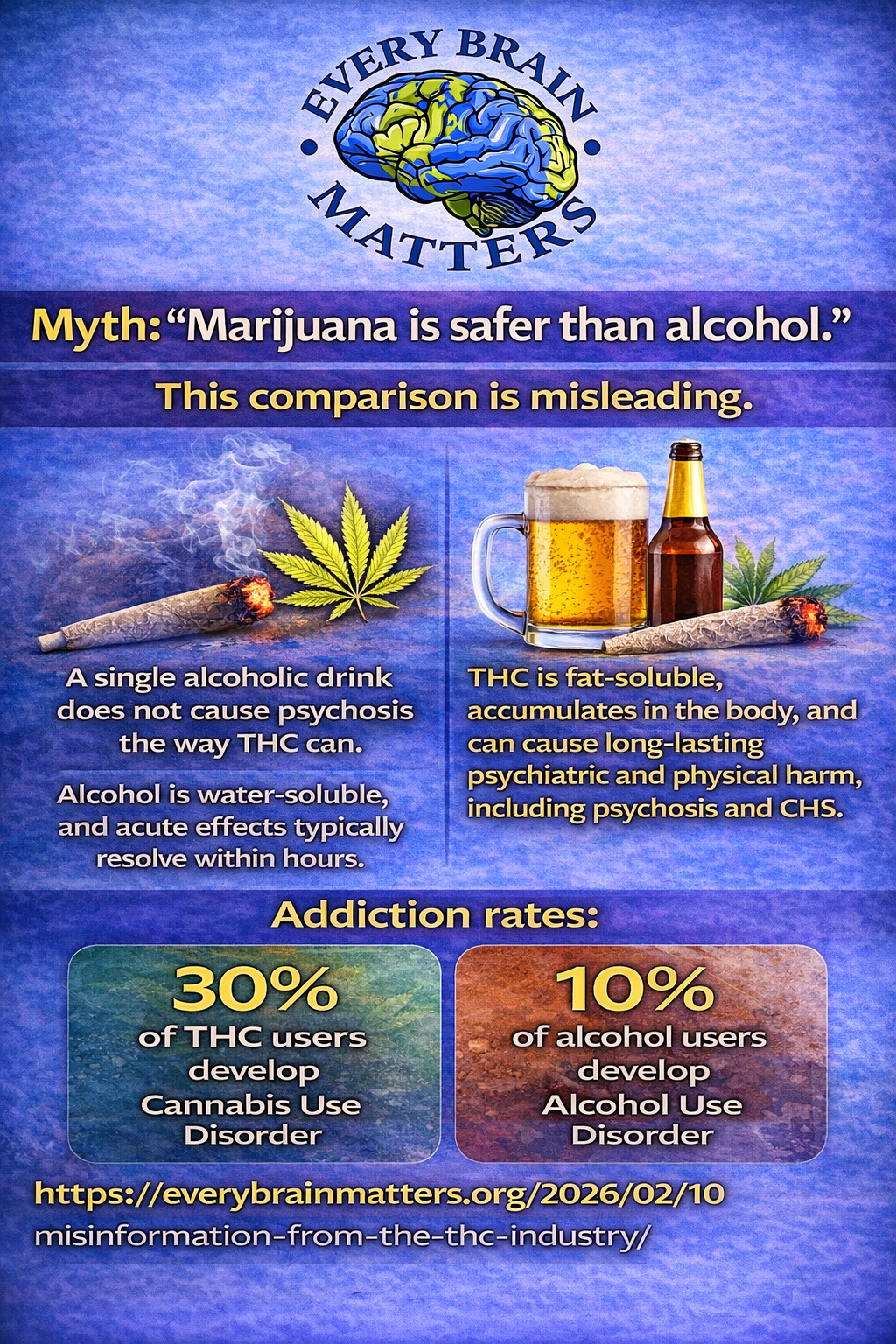
Myth: “Marijuana is safer than alcohol.”
This comparison is false and misleading.
- A single alcoholic drink does not cause acute psychosis the way one use of THC can.
- Alcohol is water-soluble, and acute effects typically resolve within hours.
- THC is fat-soluble, accumulating in the body and can produce long-lasting psychiatric and physical effects, including psychosis and cannabinoid hyperemesis syndrome, CHS.
Addiction rates:
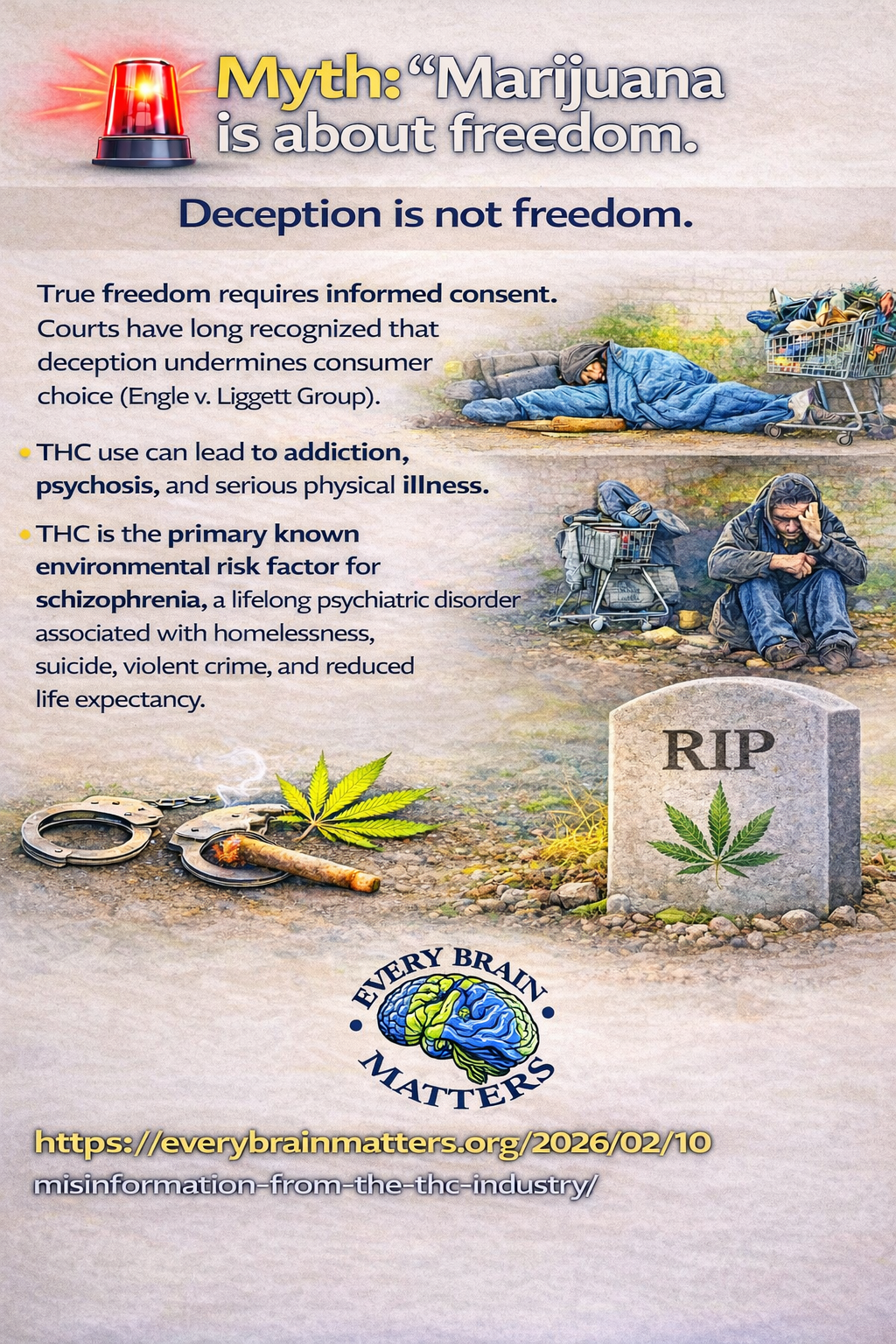
Myth: “Using marijuana is about freedom.”
Freedom requires informed consent—not deception.
There is no freedom when an industry withholds or distorts risk information. Courts have already established that deception undermines consumer autonomy (Engle v. Liggett Group). THC use can result in addiction, psychosis, and severe physical illness.
THC is the primary known environmental risk factor for schizophrenia, a chronic psychiatric disorder associated with:
- Increased crime
- Homelessness
- Reduced life expectancy
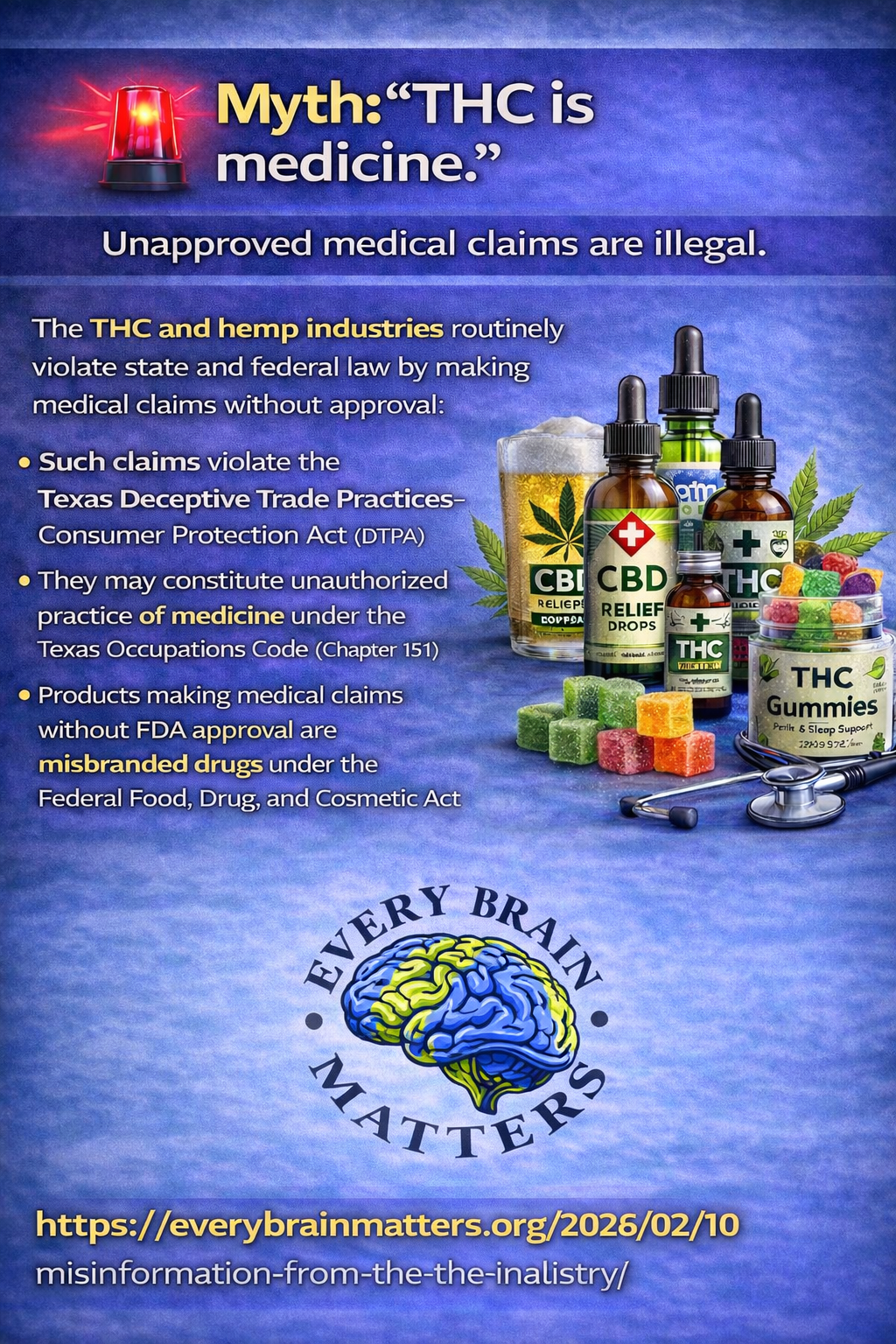
Myth: “THC is medicine.”
Unapproved medical claims are illegal.
The hemp and THC industries routinely violate state and federal law by making unsubstantiated medical claims:
- Claims such as “treats anxiety” or “cures PTSD” are misleading.
- Products making medical claims without FDA approval are misbranded drugs under the Federal Food, Drug, and Cosmetic Act
These practices are widespread and largely unenforced nationwide.
Aubree Adams, Director
Every Brain Matters (EBM) is a nonprofit that was founded by Parents Opposed to Pot. We raise awareness about the dangers of THC through education, advocacy, and compassionate support to protect the health and safety of future generations and to ensure that no one faces this struggle alone.
Please subscribe to our newsletter and make a monthly donation.
Please share this article and use the graphics below to educate your community and legislators.